Monday, August 27, 2007

Amid China's boom, pollution reaches deadly extremes

from http://www.boston.com/news/world/asia/articles/2007/08/26/amid_chinas_boom_pollution_reaches_deadly_extremes/

Amid China's boom, pollution reaches deadly extremes

BEIJING -- No country in history has emerged as a major industrial power without creating a legacy of environmental damage that can take decades and big dollops of public wealth to undo.

But just as the speed and scale of China's rise as an economic power have no clear parallel in history, so its pollution problem has shattered all precedents.

Environmental degradation is now so severe, with such stark domestic and international repercussions, that pollution poses not only a major long-term burden on the Chinese public but also an acute political challenge to the ruling Communist Party. And it is not clear that China can rein in its economic juggernaut.

Public health is reeling. Pollution has made cancer China's leading cause of death, the Ministry of Health says. Ambient air pollution alone is blamed for hundreds of thousands of deaths each year. Nearly 500 million people lack access to safe drinking water.

Chinese cities often seem wrapped in a toxic gray shroud. Only 1 percent of the country's 560 million city dwellers breathe air considered safe by the European Union. Beijing is frantically searching for a magic formula, a meteorological deus ex machina, to clear its skies for the 2008 Olympics.

Environmental woes that might be considered catastrophic in some countries can seem commonplace in China: industrial cities where people rarely see the sun; children killed or sickened by lead poisoning or other types of local pollution; a coastline so swamped by algal red tides that large sections of the ocean no longer sustain marine life.

China is choking on its own success. The economy is on a historic run, posting double-digit growth rates. But the growth derives, now more than at any time in the recent past, from a staggering expansion of heavy industry and urbanization that requires colossal inputs of energy, almost all from coal, the most readily available, and dirtiest, source.

"It is a very awkward situation for the country because our greatest achievement is also our biggest burden," said Wang Jinnan, one of China's leading environmental researchers. "There is pressure for change, but many people refuse to accept that we need a new approach so soon."

China's problem has become the world's problem. Sulfur dioxide and nitrogen oxides spewed by China's coal-fired power plants fall as acid rain on Seoul and Tokyo. Much of the particulate pollution over Los Angeles originates in China, according to the Journal of Geophysical Research.

The International Energy Agency has said China could become the world's leading producer of greenhouse gases by the end of this year, and the Netherlands Environment Assessment Agency said China had already passed the milestone.

For the Communist Party, the political calculus is daunting. The country's authoritarian system is addicted to fast growth. Delivering prosperity placates the public, provides spoils for well-connected officials, and forestalls demands for political change. A major slowdown could incite social unrest, alienate business interests, and threaten the party's rule.

But pollution poses its own threat. Officials blame fetid air and water for thousands of episodes of social unrest. Healthcare costs have climbed sharply. Severe water shortages could turn more farmland into desert. And the unconstrained expansion of energy-intensive industries creates greater dependence on imported oil and dirty coal.

China's leaders are vowing to overhaul the growth-first philosophy of the Deng Xiaoping era and embrace a new model that allows for steady growth while protecting the environment.

Yet most of the government's targets for energy efficiency, as well as improving air and water quality, have gone unmet. And there are ample signs that the leadership is unwilling or unable to make fundamental changes. 

Sunday, August 26, 2007

Fwd: [nebc] Re: World Champion?

When I learned an NEBC member won the World Bike Messenger Championships, I did some google research and found the following articles.  Each one in turn gets more descriptive and the last makes these Championships sound even more exciting than Cyclocross.
--pws


from Scott Brooks
Well, I waited a week, now I am going to out Peter Bradshaw.  A recent cat 2 upgrade from the men's team, Peter went to Ireland earlier this month to compete in the World Bike Messenger Championships.  From the snippets that I have heard, it was quite a competition.  Please congratulate Peter with me, and prod him for a race report!!!


from http://thepedalwrench.blogspot.com/2007/08/cycle-messenger-world-championship-2007.html

You make it to Dublin this year for the Bicycle Messenger World Championship?
Yea neither did I, so vicariously we have to experience the phase through pics and vids posted on the WWW. Look to Canada next year for the event followed by in 2009 moving the CMWC all the way to Tokyo.

Congrats to Peter Bradshaw of Boston and Jaimie Lusk of Denver as the new Male and Female WORLD CHAMPS! Yea that's right both Americans! Thank goodness it wasn't held in France or of course French scientist would have "found" EPO in Peter's and Jaimie's urine. Check out the vid below.


from http://www.nybma.com/

Peter Bradshaw, VeloCity Winner, is now your world Champion

Kym P. takes 2nd (plus other prizes); Austin disqualified!

The americans took home their first World Championship at this year's Cycle Messenger World Championships in Dublin, Ireland. It was controversial though. The top three finishers were disqualified for various reasons. Had those DQ's not happened, America STILL would've taken home the championship, and it would've gone to New York's Austin Horse. As it was, the rules were the rules, and Dublin's organizers stuck to their decision. It's not NYBMA.com's place to speculate, challenge, or editorialize. Our intrepid reporter didn't even qualify for the rain-soaked, off-road, finals, and spent the day in museums instead. All of the conversation around the results is second-hand hearsay, and none of the sources have the same story anyway. The top prize couldn't have gone to a better person, and he GOT there by winning the New York leg of Squid's VeloCity tour!


from http://www.movingtargetzine.com/article/more-on-the-cmwc-xv-dqs

More on the CMWC XV DQs
13.08.07 by Buffalo Bill

This year's Cycle Messenger World Championships in Dublin was probably the wettest since Edmonton, the drunkest since, oh, the last one, and maybe the most controversial since the very first one in Berlin. As I pointed out before , it's not unusual to have one or even 2 disqualifications amongst the top 10 finishers. So when I left after the finish of the main race, I was not unduly surprised to have seen a possible double dq amongst the leading 3 men. However, I was a little surprised to find on my return to London that all top 3 male finishers had been dq-ed.

This left Peter Bradshaw of Boston as the Cycle Messenger World Champion (Male) 2007. I think he is a worthy champion. I heard from Steve C (SF) that Pete got right royally w&nkered that night, stripped to his waist in the rain and was last seen looking for his prizes and his messenger bag.

The official results of the final are here. All the results from the side-events are here (if you got myspace log in).

However, as I like a good stir, and I know that it wasn't only me that was curious about the DQs, I have decided to publish Gar's account of what he saw, and how Jumbo, Austin and he himself were binned from the final standings. If you read the messengers mailing list, I apologise for reprinting messages that have come from there. Anyway, here's Gareth's totally subjective, biased and unofficial account of how it happened. happened.

Let's call this story:

How I Came to Be World Champion For Less Than A Day

Sooooo, we had some notable d.q.'s this year in the main race final, with first, second and third over the line deemed by the lads to have all overstepped the mark in one way or another. And I've read with interest this week anonymous comments on various websites and forums (fora?) either dissing the Dublin crew or the guy who wound up with the winner bag. One idiot even hoped for a new potato famine to strike the auld sod in the event of Austin not being retrospectively awarded the title. I am going to find out who that one was from and ram spuds up his hole till he loves me , but only cos he's rooting for the wrong guy ha ha! Joke, joke .

Seriously though, what went down? It seems many people are unclear on this, and I'm kind of in the know, so briefly:

Austin: seen during the race travelling with arguably non-good intentions to a checkpoint in the wrong direction around the one-way course. A d.q. offence? According to the written rules, it would seem so. This said, having spotted him in the act myself, I (perhaps selfishly) decided that as long as he finished behind me, I wouldn't be too bothered. How much of the course he got to skip through his actions isn't immediately obvious to me, certainly a tough lap, possibly more.

Roughly, his defence was – "I was on foot". roughly my reply was – "this is a bike race, not a f&cking running race and it's taking place on a one-way f&cking course", but I think I cursed more.

Fact: if me and Jumbo got d.q.'d and Austin had bitten the bullet, done his proper laps, and not had punctures or any mishaps, he still would have finished ahead of the eventual recipient of the main race winner bag [Peter]. Had me and Jumbo not got d.q.'d, Austin could have done his laps and would still have probably been on the podium. We were all a good bit ahead of fourth [this would be the eventual winner, Peter – Ed].

Jumbo: repeatedly ignored requests from marshalls to park his bike in designated areas, repeatedly jumped over cordons instead of running around them, repeatedly displayed the manners of a pig in his dealings with checkpoint people when looking for stamps, pick-ups, his manifest back etc. A d.q. offence? On paper, yes. Politeness was an absolute minimum requirement when it came to time spent with volunteers (and rightly so in such weather – some of these people got colds and worse for our benefit) at Dublin; the organisers had it written on the list of rules in the registration pack, and in Rubber-side Down too, I think.

I would still [have retained] some small jot of sympathy for him. These complaints had been communicated from an early enough stage in the race but he was let ride his ass off (and in fairness he had nothing left in the tank on the last lap) to the finish before getting the bad news ha ha! When do we get to see him on youtube firing his bike into space like an olympic hammer thrower, then cracking wooden stakes in two against his head!? Somebody definitely got it .

(for what it's worth, he later expressed to me sincere, deep regret . . . for disrespecting . . . . . . . his fucking bike – no joke)

Me: got a look at the first manifest shortly before the race actually started. Took some hurried, sketchy, ultimately non-helpful notes on its nature. A d.q. offence? Not, it turns out, covered in the written rules. I was, however, later informed of certain unwritten rules regarding the "out of bounds"-ness of the course and its checkpoints before the start of the final. I wish now, of course, that these had been written down, or, at the very least, enforced.

Nor was it me who noted that the same manifest could be looked at on the start line before the race actually started by anyone caring to look at their nearest bike wheel.

Now, while the lads were satisfied that no advantage had been gained by my seeing it (I was way down the pecking order after the first manifest), they were by the same token not so satisfied that it if this all got out, say, it wouldn't among other things look like favouritism for a local boy, what with them having the previous day d.q.ed Austin and all. For about 20 hours Sunday going into Monday, I was semi-officially world champion. Is this a record? bill will know [20 hours is the longest that anyone has ever been a world champion semi-officially – Bill].

I pointed out that I had already two years ago made my peace with the notion that some people were always going to say something like that when faced with a good showing from me in dublin, no matter what , but the lads remained unmoved . . . ( insert smiley here as mood dictates )

So what's the upshot?

I don't know for sure. If I was ever again offered a sneak preview of a manifest, I think I'd still find it hard to avert my eyes.

I think Austin shouldn't have saved himself a lap, certainly not at my f&cking expense, and most certainly not on an unmissably fluorescent orange bike.

I think Jumbo could benefit from a few terms at a good finishing school, though it may already be too late.

I think we still don't have a winner (how self-involved does that sound? Of course we do, just not to my satisfaction, and I can be notoriously picky about these things ha ha! Well done Peter, and f&ck the begrudgers, me included), but my intention is to try to rectify that at toronto next year. Maybe.

I think I'm going to go see Transformers, then the Simpsons, then watch Dublin kick Derry's arse and hopefully West Ham do the same to Man City. In Dublin it's raining a lot worse than it was last week ;-).

Tuesday, August 14, 2007

grains and sugar weaken your immune system

Excerpt from http://articles.mercola.com/sites/articles/archive/2007/07/27/echinacea-really-works.aspx

Boosting your own immune system, which is your toughest line of defense against cold viruses and other illnesses. The likelihood of you becoming a victim of the cold virus increases if you are overtired, stressed out, or eating an unhealthy diet, as all of these things can weaken your immune system.

To build your immune system to the point where it can easily fight off cold and flu viruses:
These are all effective strategies -- especially when practiced in combination.

Now cutting out grains might seem extreme, and it certainly isn't for everyone.  However, if you are a protein nutritional type, or struggle with excess weight, high blood pressure, high cholesterol or diabetes, there is a strong chance that you will benefit by significantly reducing or eliminating grains.  I know that seems like a radical statement, but that has been my experience.  I also know that if you are hooked on grains, this can be a very difficult choice.  It was for me, but once I did it, it became very easy.

Of course this, like any recommendation, needs to be individualized.  For example, if you are doing massive cardio workouts then you will certainly need extra carbs to balance your energy expenditures.  But generally speaking, limiting grains, even whole grains, is one of the best food choices you can make.

Researcher Discovers Anti-Viral Properties of Cinnamon

excerpt from http://articles.mercola.com/sites/articles/archive/2007/07/30/researcher-discovers-anti-viral-properties-of-cinnamon-with-a-hint-from-the-bible.aspx

just half a teaspoon of cinnamon a day was shown to significantly reduce blood sugar levels, triglycerides, LDL (bad) cholesterol, and total cholesterol levels in people with type 2 diabetes.

Cinnamon's other benefits include:
  • Supporting digestive function
  • Relieving congestion
  • Relieving pain and stiffness of muscles and joints
  • Anti-inflammatory compounds that may relieve arthritis
  • Helping to prevent urinary tract infections, tooth decay and gum disease
  • It's a powerful anti-microbial agent that can kill E. coli and other bacteria

The Health Benefits of Cinnamon, Nutmeg and Other Favorite Holiday Spices
Cinnamon Can Help Control Your Blood Sugar

Energy Bill Includes Bike Commuters

Wow!  I could actually get paid to ride my bike to work.
--pws

From: American Bicyclist Update

House Passes Energy Bill, Includes Bike Commuters

On August 4, Congressman Earl Blumenauer (D-Ore) joined a majority in the House of Representatives to pass landmark energy independence legislation that includes a provision to extend fringe benefits to bike commuters. The Commuter Benefit for bicyclists amends section 132(f) of the IRS code to include "bicycles" in the definition of transportation covered by fringe benefits. Included in the Ways and Means energy bill is a benefit of $20 per month for employees who bike to work. This is great news for cyclists.


Monday, August 13, 2007

GRILLED HALLOUMI equals Really Grilled Grilled Cheese

Really Grilled Grilled Cheese

Forget the bread - fire up the charcoal and cook up a batch of hot halloumi.


(Photo by Jim Scherer)

Ask an American "What is a grilled cheese?" and they'll tell you it is a sandwich with melted cheese and toasted bread. Ask the same question of a Cypriot, though, and the answer would likely be "halloumi."

Ha-what? Halloumi (pronounced "ha-LOO-mee") is a sheep's-milk cheese - or, sometimes, a sheep's- and goat's-milk cheese - from Cyprus made in a process similar to that used for mozzarella. The curd is submerged in hot liquid, which both heats and softens it, and then it's stretched. The result is a fairly firm, springy, low-moisture cheese that can be sliced, grated, and, most notably, grilled. On the grill, halloumi develops a rich, golden, flavorful crust, while the inside softens without melting. Bite into a slice of grilled halloumi, and it will squeak against your teeth.

The flavor is mild, salty, and a little tangy - assertive, yet less sharp than many fetas. Halloumi generally comes in half-pound pieces about the size and shape of an overstuff ed man's wallet. Around Boston, it is available at Formaggio Kitchen and Pemberton Farms, both in Cambridge, Sevan Bakery in Watertown, and at Whole Foods markets.

GRILLED HALLOUMI WITH LEMON AND HERBS
SERVES 4 AS AN APPETIZER

Lemon and dried oregano are a typical garnish for grilled halloumi, but fresh herbs taste livelier. Pita bread is a nice accompaniment, and it's even better if you throw it on the grill along with the cheese.

1/2 to 3/4 pound halloumi, patted dry with paper towels
1/3 cup olive oil
1/4 cup chopped fresh oregano, parsley, basil, or mint, or a combination
1 lemon, cut into 8 wedges

Prepare a charcoal or gas grill. While the grill heats, stand the halloumi on end and cut it lengthwise into four planks, each 1/2- to 3/4-inch thick, then cut each plank in half crosswise. Brush both sides of the halloumi slices with olive oil and grill over a medium-hot fire, turning as necessary, until the cheese is grill-marked and deep golden brown, about 10 minutes. Transfer from the grill to a plate, drizzle with the remaining olive oil, sprinkle with chopped herbs, and serve hot with lemon wedges.

CYPRIOT SPIEDINI
SERVES 5

Spiedini, pieces of meat or fish grilled or broiled on a skewer, belong to Italian cuisine, but we are taking some cultural liberties with this appetizer by using halloumi in the mix. If you use bamboo skewers, soak them in water for an hour or so before putting them on the grill.

1/2 loaf crusty French or
Italian bread, cut into 1 1/2-inch pieces, each with some crust
1 pint cherry tomatoes
1 pound halloumi, patted dry with paper towels and cut into 1-inch cubes
1/2 cup olive oil
1/4 cup chopped fresh oregano, parsley, basil, or mint, or a combination

Prepare a charcoal or gas grill. While the grill heats, thread 10 skewers with bread cubes, cherry tomatoes, and cheese cubes, starting and ending with bread on each skewer. Brush liberally with olive oil and grill over a medium-hot fire, turning frequently, until bread and cheese are grill-marked and deep golden brown, about 8 to 10 minutes. Remove from grill, sprinkle with chopped herbs, and serve hot.

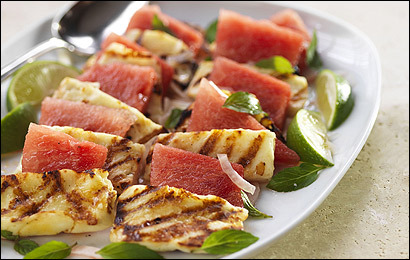
GRILLED HALLOUMI AND WATERMELON SALAD
SERVES 4

This salad is a riff on the classic combination of watermelon and feta. Not only do you have a sweet and salty flavor combination, you get contrasting hot and cold. On that note, keep the watermelon slices in the fridge, or even in the freezer, while you grill the halloumi.

1/2 to 3/4 pound halloumi, patted dry with paper towels
1/3 cup olive oil
1 pound chunk watermelon, very cold, rind removed and flesh cut into pieces about
2 inches by 2 inches and 3/4-inch thick
1/4 sweet onion, such as Maui, Vidalia, or Walla Walla, very thinly sliced
1/4 cup chopped fresh mint 1 lime, cut into 8 wedges

Prepare a charcoal or gas grill. While the grill heats, stand the halloumi on end and cut it lengthwise into four planks, each 1/2- to 3/4-inch thick, then cut each plank crosswise into quarters.

Brush both sides of halloumi slices with olive oil and grill over a medium-hot fire, turning as necessary, until cheese is grill-marked and deep golden brown, about 10 minutes. Remove from the grill, and working quickly, arrange on a large serving platter alternating with watermelon pieces to make a shingle pattern.

Sprinkle with sliced onion and mint, and serve immediately with lime wedges.

Diabetes clue found in bones

I believe the best way to control blood sugar level is to control what you eat.  But it sure is seductive to think scientists will develop a hormone-based medicine that normalizes our blood sugar level and prevents us from gaining weight even when we overeat.

And speaking of overeating, I spent 7 months losing 28 pounds for Fatty's B7 Challenge.  After my final weigh-in on August 1, I began a systematic program of overeating and gained 15 pounds in 11 days.  Time for me to start eating healthy again.
--pws

from http://www.boston.com/news/globe/health_science/articles/2007/08/13/surprise_diabetes_clue_found_in_bones/

Surprise: Diabetes clue found in bones

As medicine struggles to halt the nation's diabetes epidemic, scientists have found a potential new weapon in the most unlikely place -- the skeleton.

Bone cells, they discovered, generate a hormone that helps regulate the body's metabolism. And the lack of that hormone appears to contribute to the development of diabetes.

The work, conducted in mice, has a long way to go before it could be used to help diabetics. But a previous study showed that the substance, called osteocalcin, is found in lower quantities in people with untreated type 2 diabetes, scientists said.

"One could hope and certainly we will test if it could be a treatment for type 2 diabetes," said Dr. Gerard Karsenty, senior author of the paper in Cell magazine and chairman of the department of genetics and development at Columbia University Medical Center. "What makes osteocalcin attractive is that we all have it in our bodies and we tolerate it very well."

The study, which is the first to provide evidence for a skeletal hormone, is generating excitement among diabetes researchers. But they cautioned that it is only one of a number of substances that appear to interact to control blood sugar in the body, and scientists must learn much more before osteocalcin could be considered a medicine.

"It has opened up a new area" of research, said Dr. C. Ronald Kahn, head of obesity research at the Joslin Diabetes Center, who was not involved in the work. "But it's so unexpected, it's going to take a number of studies to figure out if this applies to humans."

In type 2 diabetes, sugar can rise to dangerous levels in the blood because the body loses sensitivity to insulin and may eventually not produce enough insulin. The body needs insulin to move digested food into cells to fuel activities. About 20 million Americans have this type of diabetes, which can lead to serious complications or death if not properly treated.

Scientists have known for years that osteocalcin is produced by osteoblasts, cells that help build bone. But the Columbia researchers are the first to show that it is also an endocrine hormone -- a substance that acts through the bloodstream to affect metabolism.

In their experiments, they inactivated mouse genes that produce osteocalcin. The osteocalcin-deficient mice grew abnormally fat and developed symptoms of diabetes, even when eating a normal diet. When the researchers gave the mice osteocalcin, the rodents' blood sugar normalized. Presence of the hormone also prevented mice from gaining weight when they overate.

Karsenty said the hormone appears to work in multiple ways to counter diabetes: it increases the body's production of the pancreatic cells that make insulin, it directly increases the secretion of insulin, it enhances the body's sensitivity to insulin, and it reduces storage of fat. No drug on the market carries that kind of punch.

Kahn called that multiple effect "particularly striking" and one of the goals for any new treatment. But another specialist, Dr. Michael A. Lazar, director of the Institute for Diabetes, Obesity, and Metabolism at the University of Pennsylvania, said two of those effects seem contradictory and raise questions that need to be explained.

Typically, he said, if the body becomes more sensitive to insulin, other mechanisms would kick in to shut off insulin production and vice versa. That makes it important to understand how osteocalcin interacts with other hormones as a next step, he said.

The diabetes specialists said that mice have proved to be a useful model for learning about human metabolism because of many similarities in genes, hormones, and functions. In this case, one of the genes that affects osteocalcin function in mice is not active in humans, but Karsenty said he believes there are other genes that serve the same purpose.

Karsenty, however, acknowledged "the possibility that osteocalcin function has been lost in evolution" and is not present in people.

The next steps, he said, are to study its effect in monkeys and then in humans over the next few years.

Karsenty's group discovered the new bone-based hormone because they were looking for the symmetry that often exists in the body. They knew that most hormones are part of a feedback loop and that a fat cell hormone called leptin helps controls bone mass. So they searched for a corresponding bone hormone that controls fat, and found osteocalcin.

"As proof of the concept that the skeleton makes molecules that act as hormones, this is the first of its kind, convincing and interesting," said Lazar. "It adds another candidate to the list . . . that could help us combat diabetes. But it's premature to be giving osteocalcin injections at this time."

Alice Dembner can be reached at Dembner@globe.com.  

© Copyright 2007 The New York Times Company

Federal panel issues warning on chemical found in plastic

What a surprise!  The chemical industry disagrees with scientists that claim plastic is harming people.
Should we throw out all our Gladware plastic storage containers?  What about water bottles?
--pws

from http://www.boston.com/news/globe/health_science/articles/2007/08/13/federal_panel_issues_warning_on_chemical_found_in_plastic?mode=PF

Federal panel issues warning on chemical found in plastic

A federal panel of scientists concluded last week that an estrogen-like compound in plastic could be posing some risk to the brain development of babies and children.

Bisphenol A, or BPA, is found in low levels in virtually every human. A component of polycarbonate plastic, it can leach from baby bottles and other hard plastic beverage containers, the linings of food cans, and other consumer products.

Culminating months of scientific debate, the decision by the 12 advisers of the Center for the Evaluation of Risks to Human Reproduction -- part of the National Institutes of Health -- is the first official, government action related to the chemical. Their recommendation will be reviewed for a federal report that could lead to regulations restricting one of the most used chemicals.

The scientists ranked their concerns about BPA, concluding they had "some concern" about neurological and behavioral effects in fetuses, infants, and children, but "minimal" or "negligible" concern about reproductive effects. The findings put the panel roughly in the middle of the debate between the chemical industry, which has long said there is no evidence of danger to humans, and environmental activists and scientists who say it is probably harming people.

No study has looked for effects in people exposed to the plastic products, which have contained BPA for 50 years.

For fetuses, pregnant women, infants, and children, the panel reported there was "some concern that exposure to bisphenol A causes neural and behavioral effects." In studies of newborn animals, low doses of BPA cause structural changes in the brain that trigger learning deficits and hyperactivity.

For adults, they reported "negligible concern about adverse reproductive effects."

John Bucher, associate director of the National Toxicology Program, which oversees the reproductive health center, said the panel gave the most weight to neurological effects in children, infants, and fetuses because studies consistently have found those effects when newborn animals are exposed to low doses similar to what people encounter. Bucher said that because the science remains uncertain, it is up to individuals to decide whether they want to avoid products containing BPA.

"To me, we're still in that stage of scratching around at the surface of this issue," he said.

Two of the panel's scientists are from private pharmaceutical companies, six from universities, and two from federal agencies. The panel was chaired by Robert Chapin, head of developmental toxicology at Pfizer Inc. 

© Copyright 2007 The New York Times Company
 

Saturday, August 11, 2007

France's model healthcare system

from http://www.boston.com/news/globe/editorial_opinion/oped/articles/2007/08/11/frances_model_healthcare_system/


France's model healthcare system

MANY advocates of a universal healthcare system in the United States look to Canada for their model. While the Canadian healthcare system has much to recommend it, there's another model that has been too long neglected. That is the healthcare system in France.

Although the French system faces many challenges, the World Health Organization rated it the best in the world in 2001 because of its universal coverage, responsive healthcare providers, patient and provider freedoms, and the health and longevity of the country's population. The United States ranked 37.

The French system is also not inexpensive. At $3,500 per capita it is one of the most costly in Europe, yet that is still far less than the $6,100 per person in the United States.

An understanding of how France came to its healthcare system would be instructive in any renewed debate in the United States.

That's because the French share Americans' distaste for restrictions on patient choice and they insist on autonomous private practitioners rather than a British-style national health service, which the French dismiss as "socialized medicine." Virtually all physicians in France participate in the nation's public health insurance, Sécurité Sociale.

Their freedoms of diagnosis and therapy are protected in ways that would make their managed-care-controlled US counterparts envious. However, the average American physician earns more than five times the average US wage while the average French physician makes only about two times the average earnings of his or her compatriots. But the lower income of French physicians is allayed by two factors. Practice liability is greatly diminished by a tort-averse legal system, and medical schools, although extremely competitive to enter, are tuition-free. Thus, French physicians enter their careers with little if any debt and pay much lower malpractice insurance premiums.

Nor do France's doctors face the high nonmedical personnel payroll expenses that burden American physicians. Sécurité Sociale has created a standardized and speedy system for physician billing and patient reimbursement using electronic funds.

It's not uncommon to visit a French medical office and see no nonmedical personnel. What a concept. No back office army of billing specialists who do daily battle with insurers' arcane and constantly changing rules of payment.

Moreover, in contrast to Canada and Britain, there are no waiting lists for elective procedures and patients need not seek pre-authorizations. In other words, like in the United States, "rationing" is not a word that leaves the lips of hopeful politicians. How might the French case inform the US debate over healthcare reform?

National health insurance in France stands upon two grand historical bargains -- the first with doctors and a second with insurers.

Doctors only agreed to participate in compulsory health insurance if the law protected a patient's choice of practitioner and guaranteed physicians' control over medical decision-making. Given their current frustrations, America's doctors might finally be convinced to throw their support behind universal health insurance if it protected their professional judgment and created a sane system of billing and reimbursement.

French legislators also overcame insurance industry resistance by permitting the nation's already existing insurers to administer its new healthcare funds. Private health insurers are also central to the system as supplemental insurers who cover patient expenses that are not paid for by Sécurité Sociale. Indeed, nearly 90 percent of the French population possesses such coverage, making France home to a booming private health insurance market.

The French system strongly discourages the kind of experience rating that occurs in the United States, making it more difficult for insurers to deny coverage for preexisting conditions or to those who are not in good health. In fact, in France, the sicker you are, the more coverage, care, and treatment you get. Would American insurance companies cut a comparable deal?

Like all healthcare systems, the French confront ongoing problems. Today French reformers' number one priority is to move health insurance financing away from payroll and wage levies because they hamper employers' willingness to hire. Instead, France is turning toward broad taxes on earned and unearned income alike to pay for healthcare.

American advocates of mandates on employers to provide health insurance should take note. The link between employment and health security is a historical artifact whose disadvantages now far outweigh its advantages. Economists estimate that between 25 and 45 percent of the US labor force is now job-locked. That is, employees make career decisions based on their need to maintain affordable health coverage or avoid exclusion based on a preexisting condition.

Perhaps it's time for us to take a closer look at French ideas about healthcare reform. They could become an import far less "foreign" and "unfriendly" than many here might initially imagine.

Paul V. Dutton is associate professor of history at Northern Arizona University and author of "Differential Diagnoses: A Comparative History of Health Care Problems and Solutions in the United States and France," which will be published in September.  

© Copyright 2007 The New York Times Company
 

Friday, August 10, 2007

Fwd: the bloodletting begins...

Armstrong: 'Things need to improve before you would see us venture back into cycling'
By Charles Pelkey
editor, VeloNews.com
Filed: August 10, 2007

Despite one of the sport's most impressive win records, the U.S.-based Discovery Channel team has failed in efforts to secure a new title sponsor and will cease operations at the end of the season.

Tour winner Alberto Contador was fending off doping allegations in Madrid, as Discovery was folding up its tent in Austin.

photo: Agence France Presse - 2007

Tailwind Sports, the parent company of the team, announced Friday that the program will end with the 2007 cycling season. Tailwind officials were apparently unable to parlay a series of eight Tour de France victories over nine years into a satisfactory sponsorship arrangement.

"Tailwind has had an amazing 10 years of success with U.S. Postal and more recently Discovery Channel as its title sponsor. This is arguably the most successful sports franchise in the history of sport," general manager Bill Stapleton was quoted as saying in a release issued Friday morning.

"This was a difficult decision, not made any easier by our recent Tour de France success," Stapleton added. "We were in talks with a number of companies about the opportunity and were confident a new sponsor was imminent. We have chosen, however, to end those discussions."

Tailwind spokesman PJ Rabice told VeloNews Friday morning that the decision was not based on "a failure to find a new sponsor."

Rabice declined to elaborate, but promised additional information later in the day.

A hunt in a difficult environment
Tailwind had been looking for a sponsor since February when a management shakeup at Discovery Channel ended with the television network announcing plans to end its support of the team. The firing of company CEO Billy Campbell, a strong advocate of the sponsorship, signaled the end of corporate support for the team and the announcement followed within days of the changes at company headquarters.

"This would not have happened if Billy Campbell was still there," Stapleton said in February. "This is about their change in management."

Stapleton and team director Johan Bruyneel had reportedly been close to signing sponsors on more than one occasion. Unfortunately, in a year punctuated by doping scandals, many potential sponsors might have been scared away by the risk of becoming mired in controversy.

One of the team's biggest strategic errors came late last year when Stapleton and Bruyneel signed 2006 Giro d'Italia winner Ivan Basso to a contract, despite the fact that he was still under investigation in the on-going Operación Puerto case. Basso later left the team, admitted to some involvement in the matter and was suspended from the sport for two years. Discovery's Campbell was also a big supporter of the Basso signing.

Indeed, Puerto suspicions have dogged the team ever since and, as Tailwind was issuing the announcement from Texas, Bruyneel and 2007 Tour de France winner Alberto Contador were meeting with reporters in Madrid in an effort to fend off allegations that the Spanish rider, too, had been involved in the Puerto case.

Bruyneel, who signed on as director with the team in 1999, said the decision to close shop was not easy.

"When I came to direct this team in 1999 I never would have imagined that we could achieve this level of success. It was an amazing time in my life and the lives of all the staff and riders associated with this team," Bruyneel said in a statement released by Tailwind.

"I'm going to miss the staff, riders and the excitement of the races, but not all the infighting between the teams. This team has become my family and it is very sad to think that we will not be together next season. 2007 has been our most successful season ever and I expect the remainder of the season to continue on that same path."

A long history
The Tailwind program dates back to 1989, when the company ran the Sunkyong amateur team. In 1992, with the support of financier Thomas Weisel, the team made the transition to the professional ranks with Subaru-Montgomery.

In 1996, just as the old Motorola program faded out of existence, the U.S. Postal Service began a nine-year sponsorship run that moved Tailwind's little Subaru team up to Division 1 status (the predecessor to the current ProTour rank) and included six of Lance Armstrong's seven Tour de France wins.

Armstrong's seventh and final Tour victory came in 2005, when the team began operating under the Discovery Channel title. The team is also credit with Roberto Heras's 2003 overall victory at the Vuelta a España and Paolo Savoldelli's 2005 Giro d'Italia win.

Armstrong said Friday that the disbanding of an otherwise-successful ProTour team might be indicative of systemic problems in the sport.

"I do not think you have seen the last of this organization in the sport, but clearly things need to improve on many levels, with a more unified front, before you would see us venture back into cycling," Armstrong said in the team's release.

History, however, may be repeating itself in that as Discovery's fortunes fade, another U.S. team - operated by Slipstream Sports - is poised to step up its program in Europe.

Winding down
The Discovery team will continue to participate in the remaining events in this year's ProTour calendar and a selection of domestic events, including the upcoming Tour of Missouri.

Bruyneel confirmed Friday that he plans to leave cycling entirely at the end of the year.

"I've achieved everything that I could in the sport," the 43-year-old Bruyneel told AFP in Madrid. "I've always said that I wanted to stop on top and I think it's the right time."

Hincapie visits with T-Mobile manager Bob Stapleton at this year's Tour of California.

photo: Casey B. Gibson

The team's riders, who represent a considerable talent pool, will certainly be the subject of serious offers from other teams. American Levi Leipheimer, who began his European career as a member of the old Postal team, moved to Rabobank, Gerolsteiner and then back to Discovery, is likely to land on his feet. Contador, however, will need to quickly address the Puerto allegations if he hopes to secure a solid contract.

At least one rider - U.S. national road champion George Hincapie - has already found a new team for 2008. Hincapie is said to have signed a deal with the T-Mobile team, run by American telecommunications entrepreneur Bob Stapleton (no relation to Bill). In contrast, the T-Mobile team got good news this week, when its title sponsor, Deutsche Telekom, reaffirmed its support through 2010.


interval training results in more fat burned

The previous article I posted, said burn more fat by riding longer.  This article says burn more fat by doing shorter intervals with breaks in between.  Which is it?  Maybe both burn fat.  Who knows?
--Phillip


Want to Burn More Fat During Exercise? Take a Break

from http://articles.mercola.com/sites/articles/archive/2007/07/20/want-to-burn-more-fat-during-exercise-take-a-break.aspx  

Allowing time for a rest period during your workout burns more fat than exercising for one continuous session, according to a Japanese study that could change the way we look at exercise.

The unprecedented study compared the workout sessions of seven healthy men with an average age of 25. Their respiratory gas and heart rate were monitored, and blood samples taken, while they performed the following scenarios:

  • A 60-minute workout on a cycling machine, followed by a 60-minute rest period (single)
  • Two 30-minute workouts on a cycling machine with a 20-minute rest in between, and a 60-minute recovery period at the end (repeated)
  • A 60-minute rest period (for control purposes)

It was found that the participants had a greater amount of fat breakdown, or lipolysis, during the repeated session than the single session.

Meanwhile, the repeated trial caused a greater increase in free fatty acids and glycerol, which are released when stored fat is burned, than did the single trial. Also during the repeated session, levels of epinephrine increased and levels of insulin decreased much more than during the single session -- a combination that may have further contributed to fat breakdown.

Current recommendations by The American College of Sports Medicine to exercise for a duration of 45 to 60 minutes may therefore not be the most effective, the researchers say. Splitting up a longer exercise session with a rest period may be more beneficial, helping people to better manage and control their weight.

Journal of Applied Physiology 102(6):2158-64 June 2007

Science Blog July 18, 2007

Dr Mercola's Comments:

The evidence continues to mount that shorter bursts of activity with rest periods in between is one of the most effective ways to exercise. This alternating technique, known as interval training or high-intensity interval training, has been around for decades but is experiencing newfound popularity as its benefits are publicized.

This most recent study confirmed that interval training results in more fat burned -- even when the session was not done at an extremely high intensity -- and a study earlier this year found that it can improve your cardiovascular fitness and your body's ability to burn fat.

During my college years, and about 15 years after that, I used to do interval training, but stopped it and just did endurance training since I haven't regularly competed for 15 years. I had no idea that the interval training had so many other benefits.

Now however, as the benefits of interval training keep pouring in,  I have been reawakened to the importance of short bursts of activity done at a very high intensity to reach your optimum level of fitness. Therefore, I now incorporate interval training (sprints) with endurance cardio training (running), pull-ups, dips and singles tennis (when I can find someone to join me!) You certainly don't have to run to achieve these benefits, and can receive similar effects using properly supervised weight training.

I believe that incorporating interval training into your exercise routine will be a welcome relief for most, particularly those who dread hour-long cardio workouts.

Although interval training requires intense periods of exercise (more intense than you may have normally done), the session is broken up with periods of rest, so it really goes by much faster yet produces excellent results.  This technique should help just about everyone who uses it;  just be sure to start out at your own pace.

So remember, along with some endurance cardio training, be sure you are also incorporating interval-type training and strength training into your exercise routine.  As with many things in life, when it comes to exercise, having some variety built in will help you to get the most comprehensive results for your mind and body.

Related Articles:

  How to Get Off Your Fat and Get the Fat Off!

 10-Minute Exercise Schedule Good for Your Heart

  Simple Inexpensive Exercise Tip


tapping the body's fat in training

from http://www.bikeradar.com/fitness/article/health-burn-fat-better-1065

Health - Burn fat better (BikeRadar ©)

By Joe Beer

For fitness riders, the question "Why would I want to be able to burn fat?" begs the obvious answer - to get in better shape and look it. But for fit athletes who already have a well-worked lipolysis system, the answer might not be so obvious.

But tapping the body's fat in training increases endurance, reduces the likelihood of 'bonking' and increases fitness. So how exactly do you improve it?

Starting with the basics, you have two choices of fuel; carbohydrate and fat. Carbs provide around 1,500 to 2,000 calories when muscles are fully 'carbo loaded'. This 'higher-octane' fuel can help you go long by combining with fat use or it can fuel quick efforts or sustained high-intensity riding on its own.

The fat stored under your skin and within muscles themselves is a very high calorie fuel depot

Even lean riders like Lance have over 30,000 calories stored as fat, and there are quite a few fit riders carrying well over 100,000. This is clearly a significantly larger potential fuel source than carbs. Fat use generally increases steadily as a ride draws out, starting with the use of fat droplets stored in the muscle and then gradually using fat circulating in the blood stream that is coming off the 'chub' stores spread around the body.Tapping the generous body fat stores saves limited glycogen, but remember even at steady riding levels you will still use carbs.

FAT BURN TIP -- Keep the ride intensity under 80% of your max heart rate (HRmax) and ride for long periods

Build the engine

Training is crucial for optimising your dual fuel burning engine. If you can increase your oxygen carrying capacity and the architecture of fat use by riding regularly you will be many times more efficient than the irregular rider.

Studies show that one effect of training regularly is that less lactate is produced at a given level of effort. For example, unfit people (VO2max=25-35ml.kg.min) may have a significant increase in lactate (LT or Lactate Threshold) at 50%VO2max. Trained athletes (VO2max60-70ml.kg.min) are likely to have this same lactate increase at around 70 to 80%VO2max.

More importantly, data suggest that fat usage may be 80% higher in athletes compared to obese individuals. Data from well-trained riders in the study (VO2max of 64ml.kg.min) suggests that fat use stops above 87%VO2max, and the peak area is around 45 to 65%VO2max. This equates to around 70 to 85%HRmax. If you want to work out the approximate percentage of VO2max you are working at, use this equation... %VO2max = (%HRmax x 1.345) -50 Eg riding at 80%HRmax gives (80 x 1.345) - 50 = 57.6% VO2max.

FAT BURN TIP -- Training regularly, even turbo training sessions, helps use fat as fuel more than any special food, supplement or psychological trick and during a 2-hour endurance ride does not save glycogen but it does significantly decrease the use of fats stored within the muscle fibres

Type One 'endurance' muscle fibres were found to be the main area of fatty droplet use. Interestingly, glycogen storage after fasted sessions, on water alone, was much greater than the feeding during the ride. This suggests these fasted water-only rides up to 2 hours could be used to boost peak levels of fat use by 50% and post-exercise muscle glycogen storage by 200%.

However, for all those pulled in by 'fat burning' spinning sessions, aerobics classes and 'step', be sure you are number savvy. Fat use probably only provides 0.5g to 1g per minute. This will be greater during later stages of training sessions and in very fit riders (maybe 600 to 800 calories per hour). But, a carb meal 30 to 90 minutes before your ride will greatly turn down your fat burning engine, switching to more carbs.

FAT BURN TIP -- Fasted rides (when you don't eat before going out) on water or fasted rides on a 5% fluid replacement drink tap fat

Have breakfast after the ride (if you're going over 2 hours eat breakfast on the bike in the form of regular carb foods - about 40 to 60g per hour)

Take a rider with bad meal timing; lack of consistent riding, who's training too hard and fat use will be very poor. However, if you leave 2 hours between eating and riding, train fasted up to 2 hours once a week, keep in your steady riding zone (60 to 80%HRmax) most of the time and stay consistent, then you will be a good fat burner.

Thursday, August 02, 2007

Genetically Modified Foods -- What to Know Before You Eat Them

from http://articles.mercola.com/sites/articles/archive/2007/08/01/genetically-modified-organisms-are-a-looming-threat.aspx

Genetically Modified Foods -- What to Know Before You Eat Them

Plus, What Food Producers Hope You Never Find Out ...

People around the world pro-actively reject Genetically Modified (GM) products and crops. But in the United States, few people are even aware of what GM foods are -- and labeling is not required.

Yet some 70% of the foods in your grocery store contain GM foods.

I'm so concerned about the grave risks in GM foods that I decided to present you with a series of articles originating from the Institute for Responsible Technology (IRT). Jeffrey Smith, leading spokesperson on the dangers of GM foods, founded the IRT in 2003 to warn the American public about this menace. Discover the hidden hazards of GM foods for yourself, at Jeffrey's website: ResponsibleTechnology.org.

Additionally, I urge you to donate to his cause -- your cause -- as I have. Please rally around and help us defeat this for-profit poison that the chemical companies are trying to force down our throats. Just surf over to ResponsibleTechnology.org/donate.

Now for the first article in this series ...

Genetically Engineered Foods -- A Source of Rising Food Allergies?

The huge jump in childhood food allergies in the US is in the news often1. But most reports fail to consider a link to a recent radical change in America's diet.

Beginning in 1996, bacteria, virus and other genes have been artificially inserted to the DNA of soy, corn, cottonseed and canola plants.

These unlabeled genetically modified (GM) foods carry a risk of triggering life-threatening allergic reactions.

Evidence collected over the past decade now suggests that they are contributing to higher allergy rates.  Scientists have long known that GM crops might cause allergies, but there are no tests to prove in advance that a GM crop is safe.2 That's because people aren't usually allergic to a food until they have eaten it several times.

"The only definitive test for allergies," according to former FDA microbiologist Louis Pribyl, "is human consumption by affected peoples, which can have ethical considerations."3 And it is the ethical considerations of feeding unlabeled, high-risk GM crops to unknowing consumers that have many people up in arms.

UK Experiences Alarming Rise in Soy-Related Food Allergies

The UK is one of the few countries conducting a yearly evaluation of food allergies. In March 1999, researchers at the York Laboratory were alarmed to discover that reactions to soy have skyrocketed by 50% over the previous year.

Genetically modified soy had recently entered the UK from U.S. imports. So the soy used in the study was largely GM. John Graham, spokesman for the York laboratory, said, "We believe this raises serious new questions about the safety of GM foods."4

Critics of GM foods often say that the U.S. population is being used as guinea pigs in an experiment. But experiments have the benefit of controls and measurement. In this case, there is neither.

GM food safety experts point out that even if someone tried to collect data about allergic reactions to GM foods, they would likely be unsuccessful. "The potential allergen is rarely identified. The number of allergy-related medical visits is not tabulated. Even repeated visits due to well-known allergens are not counted as part of any established surveillance system."5

Indeed, the Canadian government announced in 2002 that they would "keep a careful eye on the health of Canadians"6 to see if GM foods had any adverse reactions. They abandoned their plans within a year, saying that such a study was too difficult.

Creating New Proteins in a Lab -- Good For Your Health?

The classical understanding of why a GM crop might create new allergies is that the imported genes produce a brand new protein. The novel protein may trigger reactions.

This was demonstrated in the mid 1990s when soybeans were outfitted with a gene from the Brazil nut. Scientists attempted to produce a healthier soybean, but ended up with a potentially deadly one. Blood tests from people who were allergic to Brazil nuts showed reactions to the beans.7 Fortunately, this soy never went to market.

The GM variety that is planted in 89% of U.S. soy acres gets its foreign gene from bacteria (with parts of virus and petunia DNA as well). We can't know in advance if the protein produced by bacteria, never before part of the human food supply, will provoke a reaction.

As a precaution, scientists compare the new protein with a database of proteins known to cause allergies. The database lists the proteins' amino acid sequences that have been shown to trigger immune responses.

According to criteria recommended by the World Health Organization (WHO) and others, if the new GM protein contains sequences found in the allergen database, the GM crop is not to be commercialized and additional testing should be done.

Sections of the protein produced in GM soy are identical to known allergens, but the soybean was introduced before the WHO criteria were established, and the recommended additional tests were not conducted.

What If Bizarre Genes Start Transferring To Humans ...

If this protein in GM soybeans is causing allergies, then the situation may be made much worse by something called horizontal gene transfer (HGT). That's when genes spontaneously transfer from one species' DNA to another. While this happens often among bacteria, it is rare in plants and mammals.

But the method used to construct and insert foreign genes into GM crops eliminates many of the natural barriers that stop HGT from occurring. The only published human feeding study on GM foods ever conducted on GM foods showed that parts of the gene inserted into GM soy ended up transferring into the DNA of human gut bacteria.

Furthermore, the gene was stably integrated and it appeared to be producing its potentially allergenic protein. So, years after people stop eating GM soy, they may still be exposed to its risky protein, which is being continuously produced within their own intestines.

Genetic Engineering: An Exact Science... Or A Mutation Disaster Waiting To Happen?

Biotech advocates describe the process of genetic engineering as precise, in which genes-like Legos-cleanly snap into place. This is clearly a false premise.

Creating a GM crop can produce massive changes in the natural functioning of the plant's DNA. Native genes can be mutated, deleted, permanently turned on or off, or change their levels of protein expression.

Collateral damage may result in increasing the levels of an existing allergen, or even production of a completely new, unknown allergen within the crop. Both appear to be the case in GM soy.

Levels of one known soy allergen, trypsin inhibitor, were as much as 27% higher in raw GM soy.

Cooking soybeans normally reduces the levels of trypsin inhibitor, but GM varieties appear to be more heat-resistant. Levels in cooked GM soy were nearly as high as those found in raw soy, and up to seven times higher than in cooked non-GM soy.8 This suggests that GM soy allergen may be more likely to provoke reactions than natural varieties.

Another study verified that GM soybeans contain a unique, unexpected protein not found in non-GM soy controls. Scientists tested the protein and found that it reacted with the antibody IgE. IgE in humans plays a key role in a high proportion of allergic reactions, including those involving life-threatening anaphylactic shock. The fact that the unique protein created by GM soy interacts with IgE suggests it might also trigger allergies.

The same researchers measured the immune response of humans to soybeans using a skin-test often used by allergy doctors. Eight people reacted to GM soy. One of these did not react to non-GM soy. The sample size is small. But the implication that some people react only to GM soy is huge, and might account for the increase in soy allergies in the UK.

Eating More Herbicides In The Name Of "Progress"

By 2004, farmers used an estimated 86% more herbicide on GM soy fields compared to non-GM.9 Higher levels of herbicide residue in GM soy might cause health problems. In fact, many symptoms identified in the UK soy allergy study are also related to glyphosate exposure.

The allergy study identified irritable bowel syndrome, digestion problems, chronic fatigue, headaches, lethargy, and skin complaints including acne and eczema, all related to soy consumption.

Symptoms of glyphosate exposure include nausea, headaches, lethargy, skin rashes, and burning or itchy skin. It is also possible that glyphosate's breakdown product AMPA, which accumulates in GM soybeans after each spray, might contribute to allergies.

GM Soy Resists Essential Protein-Digesting Enzymes

The longer proteins survive in the digestive tract, the more time they have to provoke an allergic reaction. Mice fed GM soy showed dramatically reduced levels of pancreatic enzymes.

When protein-digesting enzymes are less available, food proteins last longer in the gut, allowing more time for an allergic reaction to occur. A reduction in protein digestion due to GM soy consumption could promote allergic reactions to a wide range of proteins, not just to the soy. No human studies of protein digestion related to GM soy have been done.

Soy's Little-Known Link to Peanut Allergies

There is at least one protein in natural soybeans that has cross-reactivity with peanut allergies.10 This means that for those who are allergic to peanuts, eating soybeans could trigger a reaction.

It is certainly possible that the unpredicted side effects from GM soybeans might increase the incidence of this cross-reactivity. But it is unlikely that it has been researched. GM soy was introduced into the U.S. food supply in late 1996.

We are left only to wonder whether this influenced the doubling of U.S. peanut allergies from 1997 to 2002.

Gambling With Our Health -- For Their Profits

Introducing genetically engineered foods into our diet was done quietly and without the mandatory labeling that is required in most other industrialized countries. Without knowing that GM foods might increase the risk of allergies or which foods contain GM ingredients, the biotech industry is gambling with our health for their profit.

This risk is not lost on everyone. In fact, millions of shoppers are now seeking foods that are free from any GM ingredients. Ohio-based allergy specialist John Boyles, MD, says, "I used to test for soy allergies all the time, but now that soy is genetically engineered, it is so dangerous that I tell people never to eat it -- unless it says organic."11

Organic foods are not allowed to contain GM ingredients.

Buying products that are certified organic or that say non-GMO are two ways to limit your family's risk from GM foods.

Another is to avoid products containing any ingredients from the seven food crops that have been genetically engineered: soy, corn, cottonseed, canola, Hawaiian papaya and a little bit of zucchini and crook neck squash. This means avoiding soy lecithin in chocolate, corn syrup in candies, and cottonseed or canola oil in snack foods.

Fortunately, the Campaign for Healthier Eating in America will soon make your shopping easier. This Consumer Non-GMO Education Campaign is orchestrating the cleaning out of GM ingredients from foods and the natural products industry.

The campaign will circulate helpful non-GMO shopping guides to organic and natural food stores nationwide, and provide consumers with regular GM food safety updates explaining the latest discoveries about why "Healthy Eating Means No GMOs".

Safe eating!

This article (part 1 of a series) is limited to the discussion of allergic reactions from GM soybeans. The evidence that GM corn is triggering allergies is far more extensive and will be covered in part 2 of this series.

Jeffrey M. Smith is the author of the new publication Genetic Roulette: The Documented Health Risks of Genetically Engineered Foods, which presents 65 risks in easy-to-read two-page spreads. His first book, Seeds of Deception, is the top-rated and #1 selling book on GM foods in the world.

He is the Executive Director of the Institute for Responsible Technology, which is spearheading the Campaign for Healthier Eating in America. Go to www.seedsofdeception.com to learn more about how to avoid GM foods.

1.          See for example, Charles Sheehan, "Scientists see spike in kids' food allergies," Chicago Tribune, 9 June 2006, http://www.montereyherald.com/mld/montereyherald/living/health/

2.          See for example, Carl B. Johnson, Memo on the "draft statement of policy 12/12/91," January 8, 1992. Johnson wrote: "Are we asking the crop developer to prove that food from his crop is non-allergenic? This seems like an impossible task."

3.          Louis J. Pribyl, "Biotechnology Draft Document, 2/27/92," March 6, 1992, www.biointegrity.org

4.          Ibid.

5.          Traavik and Heinemann, "Genetic Engineering and Omitted Health Research"

6.          "Genetically modified foods, who knows how safe they are?" CBC News and Current Affairs, September 25, 2006.

7.          J. Ordlee, et al, "Identification of a Brazil-Nut Allergen in Transgenic Soybeans," The New England Journal of Medicine, March 14, 1996.

8.          Stephen R. Padgette et al, "The Composition of Glyphosate-Tolerant Soybean Seeds Is Equivalent to That of Conventional Soybeans," The Journal of Nutrition 126, no. 4, (April 1996); including data in the journal archives from the same study.

9.          Charles Benbrook, "Genetically Engineered Crops and Pesticide Use in the United States: The First Nine Years"; BioTech InfoNet, Technical Paper Number 7, October 2004.

10.        See for example, Scott H. Sicherer et al., "Prevalence of peanut and tree nut allergy in the United States determined by means of a random digit dial telephone survey: A 5-year follow-up study," Journal of allergy and clinical immunology, March 2003, vol. 112, n 6, 1203-1207); and Ricki Helm et al., "Hypoallergenic Foods-Soybeans and Peanuts," Information Systems for Biotechnology News Report, October 1, 2002.

11.        John Boyles, MD, personal communication, 2007.


stable levels of blood sugar benefit health

excerpts from http://www.wholefoodsmarket.com/wholebody/wellness/glycemicindex.html

The glycemic index, also called GI, ranks the affect of various carbohydrates on blood sugar levels.

Current medical thinking and research suggests that stable levels of blood sugar benefit health over time.

The standard American diet still emphasizes food with a high GI value such as soft drinks, refined grains and rice, French fries and sweet desserts.

High GI value foods like these cause "spikes" — a rapid rise and fall — in blood sugar and insulin levels because the body digests and absorbs them so quickly. These episodes have been linked to greater sensations of hunger and higher stress hormone levels. Experts believe that diets filled with high glycemic index foods may lead to overeating, obesity and adult onset diabetes.

Some of the benefits gleaned from consuming low-glycemic carbohydrates and maintaining stable blood sugar levels include:

  • Weight control
  • An increase in insulin sensitivity
  • A lower risk of heart disease
  • Healthy blood cholesterol levels
  • An increase in satiety
  • Improved physical endurance
  • Faster recovery from exercise

Daily use of the glycemic index boils down to replacing highly processed grains and sugars with whole grains, vegetables and fruit — and avoiding high GI foods by themselves.

Soft drinks and other sweetened beverages are particularly notorious in this regard. Try substituting soft drinks [ed.: and fruit juices] with sparkling water or unsweetened tea to avoid those nasty spikes in blood sugar.

Cooking methods and serving temperatures can affect the GI value of foods.

  • Pasta, for example, should always be cooked and eaten al dente or "firm to the teeth," since overcooking will raise its GI value in addition to reducing its texture and flavor. Though a processed food, al dente pasta has a low GI value due to a unique bonding of the carbohydrate with gluten, making it more difficult to digest.
  • Potatoes have a lower GI when boiled rather than baked, and when served cold, as in potato salad. Acidifying the meal with lemon juice or vinaigrette also lowers its GI value.
  • Sourdough bread has a lower GI value than yeasted breads.

Here are some examples of foods with low GI values:

  • All non-starchy vegetables including spinach, onions and broccoli
  • Temperate fruits, such as berries, cherries, apples and pears
  • Nuts, seeds and legumes
  • Unsweetened yogurt and cheese
  • Whole grains that are minimally processed, preferably with the whole kernel, such as steel cut oats, brown Basmati rice, dense whole grain breads with nuts, seeds or sprouted grains, sourdough bread, lightly sweetened granola or muesli and al dente pasta
  • White flour and whole wheat flour have similar high glycemic index values. For this reason, when eating whole wheat bread, make sure that the bread you choose contains whole grains or kernel for an optimal GI value. 

Here are some examples of foods with high GI values:

  • Refined flours and grains
  • Refined sweeteners
  • Low-fiber breakfast cereals
  • Sweetened beverages, including soft drinks and juice
  • Tropical and dried fruits
  • Starchy vegetables such as potatoes, squash and corn

Here are some other ways you can promote blood sugar stability:

  • Cut hydrogenated or partially hydrogenated oils from your diet completely. The trans fats found in hydrogenated oils have been shown to interfere with insulin secretion and increase blood sugar levels.
  • Be sure to eat enough fish or take fish oil supplements.
  • Chromium and magnesium are vital for the body to properly maintain healthy blood sugar levels. Consider supplementing if dietary levels are not sufficient.
  • Try to eat adequate meals throughout the day, and then minimize snacking or eating between meals. If you do snack, use the principles of the glycemic index to make good choices, such as a handful of nuts or some plain yogurt with fruit instead of potato chips or pretzels.
  • Eat plenty of fiber, especially soluble fiber.
  • Take prebiotics such as inulin to promote healthy intestinal tract bacteria.
  • Cinnamon and prickly pear cactus purportedly help regulate blood sugar.
  • Maintain your muscle mass.

Recent research shows that a glass of wine or beer during or before meals helps to keep blood sugar levels healthy.