Monday, September 24, 2007

Gain from pain - Buoniconti case helped with Everett's treatment

from http://www.boston.com/sports/football/articles/2007/09/23/gain_from_pain/

Gain from pain

Buoniconti case helped with Everett's treatment

MIAMI - This is a story about good karma, with a tough beginning, a ton of tears, but a happy ending.

On Oct. 26, 1985, 19-year-old Citadel middle linebacker Marc Buoniconti suffered a dislocation of the third and fourth cervical vertebrae and a severe spinal cord injury while making a routine tackle. Now 40, Buoniconti has spent more than half his life in a wheelchair. Two weeks ago, Buffalo Bills tight end Kevin Everett injured the same two cervical vertebrae while making a routine tackle. Doctors say Everett will walk soon. And he can thank Buoniconti.

Turn back the clock 22 years. Buoniconti will never forget the fateful hit. "My body dropped like a ton of bricks," he said. "As my arm hit the ground, I knew I was paralyzed."

He couldn't breathe. He thought he was going to die.

"I remember saying to myself, 'Don't freak out.' "

His father, Nick Buoniconti, the Hall of Fame middle linebacker for the Boston Patriots and Miami Dolphins, was in New Jersey sipping champagne with his Notre Dame college roommate when the phone rang. He rushed to his son's bedside.

Marc was on a ventilator and could not speak.

"I'll never forget the look in his eyes," Nick Buoniconti said. "His big brown eyes read, 'Dad, help me.' It was the first time in my life I couldn't help my son."

Oh, but he would help - in a major way. Nick Buoniconti - the centerpiece of the famed No-Name Defense that was instrumental in the Dolphins' perfect season in 1972 - went on the offense.

"My dad made a promise to me that he would do anything and everything in his power to raise the money to find a cure, and I said I would join him to try and make that promise come true," Marc said.

Nick Buoniconti found a University of Miami neurosurgeon, Dr. Barth Green, who was tired of telling parents their child would never walk again. Green told him, "Get your son to Miami and I'll save his life."

Buoniconti did more than that. He decided to use his fame to raise money for a cure. He and Green founded the Miami Project to Cure Paralysis, the world's largest comprehensive spinal cord injury research center, at the University of Miami.

In 1985, nobody was talking about finding a cure for spinal cord injuries.

"Oh yeah, man, it was borderline inappropriate back then," said Marc Buoniconti from his breath-controlled wheelchair. "When I first got hurt, there was nothing being done in research for paralysis."

The trio worked tirelessly, and to date they have raised more than $200 million for research. There are now 200 scientists, doctors, and researchers working under one roof.

"Dr. Green laid out his vision, the best scientifics under one roof," said Marc. "It was very gutsy. They called him a quack, they called him a wishful thinker, a glory seeker. He was spreading false hope.

"But he didn't care, because look at his job. At some point you have a frustration level. But then fate steps in. Dr. Green was ready to give up, and then that's when I had my accident and came down to Miami."

Green acknowledges he was nearly defeated.

"I was pretty beat up back then," he said.

Instead, the researchers and doctors worked on a hypothermia cooling technique that if administered quickly after the trauma could limit the damage. They also worked on finding a way to create healthy cells to offer a cure.

A bold decision

On Sept. 9, Everett stopped moving after making a helmet-first tackle in the season opener against Denver. His teammates prayed. Initial reports were that Everett suffered a catastrophic, life-threatening injury. He would be paralyzed. Forever.

Here's where the karma comes in.

The Bills' team neurosurgeon, Dr. Andrew Cappuccino, earlier this year had attended a hypothermia treatment seminar given by the scientific director of the Miami Project, Dr. W. Dalton Dietrich. The idea is to quickly lower the body temperature to 92 degrees by using an ice-cold saline solution that prevents swelling and further damage, giving drugs a better chance to work.

Dietrich was watching the Bills game. The Bills' owner, Ralph Wilson, is a Miami Project fan. He has donated millions to the Buoniconti Fund - there's a plaque with his picture in the lobby of the Miami Project - and he is close friends with Dr. Green. Everett is a former University of Miami player.

There was a stream of phone calls and e-mails between Miami and Buffalo.

Cappuccino ordered paramedics in the ambulance to immediately start running an IV with cold saline.

"It was less than 15 minutes after Everett hit the turf," Green said. "It was a bold decision - the first time a paralyzed patient or any patient following any kind of a brain or spinal cord injury has received this therapy within 15 minutes of a catastrophic injury. The results are amazing. And because of it, Everett will walk again."

Within 90 minutes, Everett was in the operating room, where doctors repaired the dislocation of the spine and took pressure off the spinal cord.

Green talked to Cappuccino and helped him locate a Cool Gard, an intravascular cooling device that was inserted by a catheter into Everett's femoral vein near his groin.

"Talk about karma, there was one machine in all of Buffalo, and it happened to be in Cappuccino's hospital in a closet in the ICU right on the floor he was working," Green said.

Everett eventually started to move his limbs and experience feeling in his hands. He was transferred to a Houston hospital Friday to be closer to his family and friends.

"It's medical history," said Green. "He's out of the woods and on his way to walking soon. The best-case scenario is he'll walk and be very independent. He'll be able to work but not as a football player, probably.

"The Miami Project has been swamped with calls from everywhere. You're going to see patients across the country getting this treatment next week because of what Dr. Cappuccino did. It will also work for car accident victims and heart attacks. This is a very big deal.

"We want to put all our hands together. We hope to meet with all NFL doctors to see if we can get a consensus to give this a try and do it at other places. Colleges all around the country want to join hands with us."

Reason for optimism

According to the National SCI Statistical Center, 11,000 new cases of spinal cord injuries occur in the United States each year. Human trials will start next year at the Miami Project on a healing treatment for chronic cases like Buoniconti's.

The growing of Schwann cells to repair damaged spinal cords has returned 70 percent of walking functions in tests done on rats.

"Schwann cells are able to reinsulate wires of spinal cords so they can conduct electronic messages and let the person move again," Green said.

That could help Buoniconti walk again.

"I've never been more excited or more optimistic," he said. "I think I've realized how close we're getting. I think we've dinked it and dunked it all the way down the field. We're in the red zone, that's for sure.

"It sure would be nice to take advantage of a cure after 22 years. I get emotional because I've seen an ignorance crumble, which is beautiful."

Now at the Miami Project's Lois Pope LIFE Center, Buoniconti works out three times a week on a robotic treadmill. It hoists him using a crane and moves his legs to improve his cardiorespiratory rate and increase bone density.

Marc Buoniconti said a cure means so much more than football ever did.

"I've scored TDs on interceptions before," he said. "I know the euphoria of making a tackle on fourth and 1. I've done that. I could only imagine the kind of glory I'd get getting out of this wheelchair.

"I don't believe things happen for a reason. I believe things happen and you make a reason. You respond to adversity and I dedicated my life to raising money and awareness for getting a cure. Little did I know that decision I made in a hospital would lead to this.

"Look at Kevin Everett. Was that not a cure? He owes a big thank you to our researchers."

NFL denies grants

But if you want to see the fire that still burns in Marc Buoniconti's eyes, just mention the NFL. In his mind, the acronym stands for No Funds Lately.

"Initially they were supportive of the Miami Project, but years ago they just pulled the plug on us and started denying our grants," Buoniconti said. "We're on the verge of clinical trials in humans.

"For the NFL to say it's not important research or it's not a priority, I think, is irresponsible, I think it is unfair to the current players, and in a way is a slap in the face to my father and any player who goes out on the field and has the potential to have a spinal cord injury. I'm hopeful they will rethink their position.

"Are they really interested or are they appeasing everybody by doing a little here or a little there or are they actually going to take a real focused approach to help their players?

"There's injuries in the past - Darryl Stingley [Patriots], obviously Dennis Byrd [Jets], Mike Utley [Lions], Reggie Brown [Lions], Kevin Everett. And there will be more in the future.

"Don't turn a blind eye, don't think, 'Out of sight, out of mind.' You've got to be progressive and proactive. And responsible."

NFL spokesman Greg Aiello said NFL Charities donated about $1.5 million to the Miami Project between 1985 and 2002 and bought a table at this year's fund-raising dinner. He added that the NFL enlisted a group of doctors to sift through the ever-increasing applications for funds and that "they decided to focus more on concussion research.

"We look forward to giving their application strong consideration in the future."

Buoniconti was not appeased.

"That's a window-dressing response, focusing more on concussions," he said. "So spinal cord injuries are not important, I guess. Tell that to Kevin Everett and anyone else who puts on a helmet. Ask them if they're more scared of a concussion or a spinal cord injury."

Last Monday, the Miami Project to Cure Paralysis raised nearly $6 million at its annual dinner at the Waldorf-Astoria in New York. A round of golf with Jack Nicklaus went for $250,000. A flag that flew on top of Saddam Hussein's palace in Baghdad on the Fourth of July brought in $200,000.

Buoniconti says he cried like a baby at the dinner. Tears of joy. Tears of appreciation.

"I'm turning into a big baby," he said. "My dad gave of his own life for me. He has devoted a large part of his life to help me. He's dedicated most of it to me. My mom is the backbone of the family, even though they are divorced. It humbles me and I feel an enormous debt. It has brought us together.

"Let me tell you what he said in his Hall of Fame speech [in 2001]. 'I've had many accomplishments. Two Super Bowl championships, the unbeaten perfect season. I would trade this ring in and all my individual accomplishments if one thing could happen in my lifetime. As a father, I would like nothing more than to walk by his side. I'd give it all up to walk with my son again.'

"I have such vivid memories of me walking. I rarely dream that I'm in a chair. I'm always moving, I'm a free spirit when I'm sleeping."

Buoniconti's brown eyes glisten, but his voice is steady.

"I'll be going to get up and leave this chair and go and hug my mom and dad," he said. "I'm hugging my mom and dad first." 

© Copyright 2007 The New York Times Company

Thursday, September 20, 2007

Tom Brady: Star quarterback, style icon

from http://www.boston.com/sports/football/patriots/articles/2007/09/20/two_point_conversion/

Two-point conversion

Tom Brady: Star quarterback, style icon

Yes, that is Tom Brady, staring out at you from the cover of the 50th anniversary issue of GQ, his mouth slightly open, his stubble spread just so around his dimpled chin. The portrait shows a hint of football player - the guy probably looks this intense in a huddle - but it doesn't conjure the helmeted hero who drove his team downfield to victory Sunday.

No, this version of Brady has everything to do with style: a pressed collar, a brooding gaze, an image aimed far past the classic sports faithful. This is the man who favors Zegna suits, who topped Esquire's list of best-dressed men this year. This week's GQ goes so far as to name him one of 50 historical "icons of cool" and to say that his bearing imparts a lesson for the ages: "Pay as much attention to your hair as to your suit."

It caps a remarkable trajectory over Brady's mere six years in the public eye. When he first emerged as the Patriots' accidental quarterback in 2001, the guy was an oversized puppy dog, all eagerness and wide-eyed wonder. Sports Illustrated put him on its cover fairly frequently but usually in helmet and grease paint. True, in one early cover, he was naked from the waist up, alongside the headline "The Natural." But he faced the camera head-on, clean-shaven and grinning, looking almost nerdily all-American.

Not so in the photos that have appeared this summer and fall, in a remarkable series of spreads in glossy men's magazines. This Brady is suave and sophisticated, calculatedly cool. In GQ, he posed for fashion photographer Richard Burbridge with grease paint on his face, but a pinstriped suit below. In the magazine Best Life, he stared stonily into the distance in a high-end coat. In the fashion glossy VMAN, he posed in a wet T-shirt and let someone pour water on his head.

He's offered enough images, in other words, to appeal to nearly everyone. And calculatingly or not, he's expanded his brand and his fan base into some unlikely quarters. There's money at stake, of course: Brady lately signed on as a spokesman for Stetson cologne and high-end Movado watches. But Brady also has succeeded in cultivating love. Many on the VMAN staff didn't know who he was before he posed for the spread, said executive editor Julie Anne Quay. Now, she said, her office is filled with Patriots fans.

That's the sort of cross-cultural feat that only a few sports stars can manage, says sociologist Michael Kimmel, author of "Manhood in America: A Cultural History." He compares Brady to soccer superstar David Beckham: "Somebody who can in some way stand in for athletes so that men will like him, but is handsome enough, rugged enough, and softened enough that women will like him. . . . You want a kind of heartthrob he-man."

That's Brady, and partly, that's the luck of genetics. He has the build, the chin, the hair, the natural ability to get the girl, even if the girl is a Brazilian supermodel. He's also comfortable in his skin, effortlessly handsome - and, apparently, as unflappable in front of photographers as he is on the gridiron. Magazine editors say he was good at taking pictures long before he was romantically linked to supermodel Gisele Bundchen. Those come-hither VMAN shots were taken in January, just as the Brady-Bundchen relationship began, Quay says.

"This is all Tom," she says.

Indeed, Quay and other editors say Brady is an eager participant in photo shoots, asserts a few opinions of his own, and arrives with a firm sense of self. "He knows his light, he knows his angle. He has a certain amount of trust with the photographer," says John Mather, the fashion director of Best Life who arranged September's spread, which features Brady in a new line of Tom Ford clothes.

To some degree, he has extended that trust to magazine writers, who accompany the photos with gushing interviews. With the local sports press, Brady tends to be circumspect, never treading far from his team-player script. When Globe Magazine writer Charlie Pierce proposed a book about Brady in 2005, the quarterback declined to take part. And when the Patriots' videotaping controversy broke, the quarterback offered typical platitudes: "You come out here, and you try to play the best that you can." (Patriots spokesman Stacey James declined, on Brady's behalf, a request to be interviewed for this story.)

In magazine interviews, Brady shares specifics, some light, some fairly deep. He told Best Life that he listens to U2 and Jay-Z. He told Details in May that he was nervous about his impending fatherhood. He told VMAN that he had soured on the dream of entering politics, and that he roots for the Yankees as well as the Red Sox.

Granted, magazines are posing different sorts of questions. But they're also far more likely to support the Brady brand, to dwell on the underdog nature that he still cultivates, three Super Bowl victories later. (Quay says one reason her magazine wanted to feature Brady was "that he wasn't the first draft pick." Brady was picked in the sixth round, and was the 199th player chosen in the 2000 draft.)

The sports press deals in tough love: its archetypal stories are of heroes knocked off pedestals, legacies questioned, fans demanding more. In fashion circles, everyone wants Tom Brady to look good.

Third Super Bowl the charm
If one act of photography converted Brady from eager athlete to style icon, it might have been the GQ spread in the spring of 2005. The Patriots had won their third Super Bowl, and GQ wanted to highlight Brady as "the all-American guy," recalls Jim Moore, the magazine's creative director. They chose Bruce Weber - "the all-American photographer," Moore says - to take the shots. And they decided that, to play off Brady's movie-star looks, they would dress him in various costumes. He'd be an admiral, a cowboy, a ranch hand cradling a baby goat. Implication: The guy could do anything.

The process took time, Moore says. A fitting one day took a couple of hours. Then came a daylong shoot, with six or seven locations and some 14 costume changes. Brady "was totally game for it," Moore says, and gracious throughout. He introduced himself to everyone on the set, and bade them goodbye by name. At one point, Moore recalls, Brady was in the middle of a field, due for a clothing change, and didn't flinch when he couldn't get back to a van for privacy. "He said, 'I'll just change here. Don't worry,' " Moore says.

That lack of diva-ness, widely reported, has earned Brady enduring fans in the fashion press. It also helps that Brady is truly interested in clothes. Mather, of Best Life, says Brady loved the idea of appearing on the cover in a tailored suit.

"It's something he and I talked about," Mather says. "He's done enough T-shirts and casual kinds of shootings."

The Best Life shoot took place at a Boston studio in June, Mather says, and Brady took a liking to the Tom Ford clothes that were specially fitted for him. At one point, he asked if he could buy a leather jacket to wear on an upcoming trip to Las Vegas. Best Life called Ford's company, which said he could go ahead and keep it.

Brady is hardly the first sports star to develop a sense of style as his star rose. GQ's "Icons of Cool" spread features a range of athletes, from Bjorn Borg to Michael Jordan, Arnold Palmer, and Olympic skiing champion Jean-Claude Killy. Still, it's rare to find football players so involved in the fashion world, says Michael Oriard, a former NFL player and author of "Brand NFL: Making and Selling America's Favorite Sport."

For one, most NFL players are built like large appliances; they don't have the physique to carry off the standard menswear. But football also peddles a particular brand of masculinity, which doesn't encourage a man to be seen as a sexual object. A few players, historically, have bucked the trend, Oriard says. In the 1970s, players Jim Brown and Fred Williamson posed for Playgirl. And the famously stylish Joe Namath donned pantyhose for the sake of an endorsement, posing suggestively in a 1974 TV ad for the hosiery brand Beautymist.

That commercial came with a message for old-school football fans: The last shot was of Namath being kissed by a woman, as if to confirm his heterosexuality. Brady doesn't seem to require such reassurances. To Oriard that suggests an expanded view of masculinity - and expanded opportunities for Brady to peddle himself.

If anything, Kimmel says, the fashion shots make Brady look unguarded, almost vulnerable, and reinforce a sensitive persona that appeals to female fans. That image, Kimmel says, might be helping Brady weather other public relations challenges - particularly the baby drama that has played out so prominently in gossip magazines.

When US Weekly reported that Brady wept at a Santa Monica, Calif., hospital, where he visited his new son and ex-girlfriend Bridget Moynahan, Kimmel says some women probably read the news and swooned. If a star doesn't have "this chiseled, gritty masculinity," Kimmel says, "that enables [him] to actually move beyond it."

Still, it can be tricky business, appearing in magazine glamour shots while reporting to work in a locker room. Moore said Brady knew, going into the 2005 GQ shoot, that the results would earn him a certain amount of razzing. Indeed, when the magazine came out, some Patriots players taped its pages to their backs during a public practice. "The one with a goat," offensive lineman Dan Koppen recalled last week. "We sort of have to regulate his status in the locker room."

But if Brady's pinup history draws wisecracks from his teammates, the humor tends to be good-natured and resigned. In football these days, nobody frowns on self promotion.

"What he wears probably wouldn't fit me," jokes Patriots linebacker Rosevelt Colvin. "My wife would probably laugh at me. My kids would probably laugh at me. But for him, it works well.

"He has the face for it, man. You got the style, you got the opportunity, I say go for it."

Joanna Weiss can be reached at weiss@globe.com 

© Copyright 2007 The New York Times Company
 

Re: Making Boston a bicyclist's dream

from http://www.boston.com/news/globe/living/calendar/articles/2007/09/20/get_your_ride_on/
Get your ride on
Looking for a spot for an urban bike ride? Try these lesser-known routes.

September 20, 2007

Mystic River paths
Where Run through Everett and Medford, with easy access in several spots.
Pros Meander along the Mystic River.
Cons Meander along the Mystic River.

Pierre Lallement Bike Path
Where Follows the Orange Line for about 4 miles, starting at Mass Ave. and ending at the Arborway.
Pros Traffic-free, easy riding.
Cons Frequent trains passing by make for a noisy ride.

Forest Hills Cemetery
Where Off the Arborway in Jamaica Plain.
Pros Paved roads with nice views.
Cons Open to vehicle traffic; general creepiness.

Stony Brook Reservation
Where Hyde Park.
Pros Paved path in gorgeous nature preserve.
Cons Hard to get to. 

Re: Making Boston a bicyclist's dream

From the Boston Globe, 9/20/07

Re: Making Boston a bicyclist's dream

from http://www.boston.com/news/globe/living/calendar/articles/2007/09/20/boston_by_bike/?page=1

Boston by bike

The city is gearing up to make much-needed improvements; but even now, it's a great way to get around

Boston is a miserable city for bikers. The roads are glorified cowpaths - rutted, full of potentially lethal potholes, and loaded with sharp curves and odd meanderings. To call the weather inhospitable and unpredictable does not do justice to the 30-degree temperature swings of spring days or the 45-mile-per-hour winds of an early fall northeaster. Boston drivers are a national joke, and the midday traffic downtown is enough to make anyone considering a noontime ride head to the gym instead.

That, at least, is the perception. The reality is not that grim, city cyclists and officials say. And while Boston may not yet be on the level of bikers' paradises such as Portland, Ore., or Berkeley, Calif., there is something of a two-wheel renaissance underway in the Hub, and it's gaining momentum by the day.

Consider the city's new initiative to improve biking in Boston, which could include everything from adding bike lanes, racks, and rental stations to creating online maps that plot bike-friendly routes. On the more immediate horizon, there's this weekend's Hub on Wheels event, a mass bike ride and festival that is expected to draw upward of 4,000 riders, twice the number who rode in last year's edition. The city is closing down Storrow Drive for the ride, which benefits the Boston Digital Bridge Foundation, and riders will bike through some of Boston's more scenic real estate, including the Arnold Arboretum, Stony Brook Reservation, and Franklin Park. At the front of the pack will be Senator John Kerry and possibly Mayor Thomas Menino, a recent biking convert who is now preaching the cycling gospel throughout the city.

"There's no better way to see the city than on your bike," says Nicole Freedman, the organizer of Hub on Wheels and a former Olympic road cyclist who rides all over the city for transportation and fun. "I think it's really key for the future of Boston, too, in terms of the environmental impact and the need to reduce pollution."

Freedman is a passionate advocate of both the health benefits of biking and the virtues of Boston as a biking city. She commutes to City Hall each day from her home in Jamaica Plain and only uses a car as a last resort. "There are places in the city, like JP and Stony Brook, that you might have driven through, but if you see them on a bike you realize how beautiful they are," she says.

The Stony Brook Reservation is a prime example. Situated deep in Hyde Park off Washington Street, the reservation has miles of paved bike paths set among 425 acres of beautiful parkland. A lesser-known cousin of Franklin Park and the Arboretum, Stony Brook doesn't get as crowded as some of the other popular biking spots in town. "You get in there, and you don't even know you're in the city," Freedman says.

By virtue of her position as director of the Digital Bridge Foundation, a nonprofit that provides computers and training to under-funded schools in the city, Freedman has the mayor's ear. He's taking a personal interest in making the city friendlier for bikers, she says, not just because of his own biking habit but because of the need to reduce traffic congestion and pollution.

If a big ride like Hub on Wheels is too much for you, there are plenty of other options for pedaling around the city. After years of commuting to and from his accounting job by bike, Andrew Prescott decided he liked his commute more than his job. So he ditched the corporate gig four years ago and started Urban AdvenTours, a small outfit that leads organized bike tours of the city. He shows small groups Boston's hidden corners, taking them down the Jamaicaway and around Beacon Hill.

Prescott rides from Charlestown into the city to work and believes Boston has much to offer even for casual cyclists. "Go ride Boylston Street at night or the Greenway toward the Seaport and tell me there's nowhere to ride. I love riding in the city," he says. "Comm. Ave, if you catch the lights right, you can fly through the city. If the drivers give you a hard time, just smile at them. You have to act like a car if you're a city rider."

The city's roads and bike paths still need a lot of work, however. "It hasn't gotten any better in the recent past," says Chris Porter, president of the Boston chapter of MassBike, a nonprofit cycling organization. "There are almost no bike lanes; there are a lot of areas without bike parking."

Comm. Ave and Boylston don't have dedicated bike lanes or paths, but both are favorites of Boston bikers, as is the South End, and those cyclists ambitious enough to tackle Charlestown's hills are rewarded with commanding views of the city. But there are plenty of other good rides to be had around town if you know where to look (see sidebar for a few lesser-known places).

The path that runs along both sides of the Charles River is the go-to route for many riders, and for good reason. The mostly flat, paved path offers miles of traffic-free riding with only the occasional stop at intersections. The path is popular with runners and rollerbladers too, though, and can be crowded on nice days.

Chris Newell, a veteran rider both in Boston and other cities, uses his bike as his primary mode of transport and, over the years, has become expert at devising good routes through the city. "The new Harbor Walk and the paths along the Mystic River are great for cyclists. The Big Dig has also added another route through the city [on the Greenway]. The new Southwest Corridor path to JP coupled with the Emerald Necklace path and you have a fantastic ride to the Arnold Arboretum covering so many diverse neighborhoods," says Newell, who runs a small nonprofit organization. "The rail-to-trail Minuteman path beyond Alewife is great, too."

Many European cities and some in the United States have networks of interconnected urban bike paths that are dotted with bike stations. These small buildings offer secure bike parking, showers, and lockers and are the key for folks who would rather ride to work than drive.

"The reason more people don't ride to work here is there's no bike parking," says Prescott. "If we had bike stations near South Station, North Station, and one or two other places, it would facilitate people riding to work."

The ultimate goal for Prescott, Newell, and other biking enthusiasts is to see Bostonians embrace biking on a large scale, creating a critical mass of cyclists that would in turn encourage others to get out and ride.

"When there are more bikes out, it becomes a cause-and-effect thing, where more people become aware of it and want to go out and ride," says Porter. "A lot of times it's the shortest way to get from A to B in the city." 

© Copyright 2007 The New York Times Company

Making Boston a bicyclist's dream

from http://www.boston.com/news/local/articles/2007/09/20/pedal_pushing/

Pedal pushing

Menino mounting bid to make city a bicyclist's dream

Potholes, narrow roads, mean drivers.

Riding a bicycle in Boston is something akin to combat. Cyclists routinely rank the city America's worst.

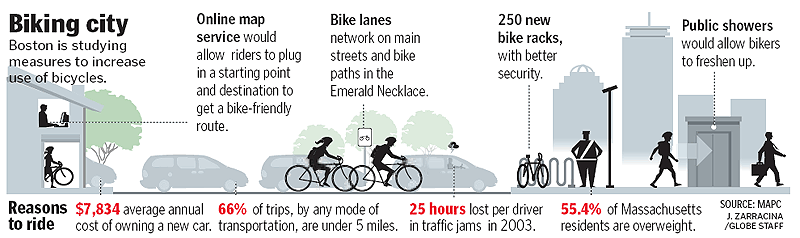
Stung by national criticism and hoping to take a bite out of traffic and air pollution, Mayor Thomas M. Menino is vowing to change that. A newly converted cyclist himself, Menino will announce today the hiring of a bike czar, former Olympic cyclist Nicole Freedman, and a first phase of improvements to include 250 new bike racks across Boston and an online map system.

In the next several years, Menino said, he plans to create a network of bike lanes on roads such as Massachusetts Avenue and Commonwealth Avenue in the Back Bay and the Fenway. Paths could also be constructed to connect the Emerald Necklace system of parks, and the mayor is looking at facilities like showers, bike storage areas, and automated bike rental systems that make wheels instantly available to anyone with a credit card.

"We need to get more people to take the bike around. It's good for their health, it's good for the environment, and there's less congestion on our streets," Menino said. "It's time for this issue to come to the forefront."

So far, the city's most ambitious plans are in a brainstorming phase and could change, officials said. No money has been budgeted for the improvements, and neither Menino nor other officials could offer any commitment on when or exactly what the city will ultimately do. By contrast, New York Mayor Michael Bloomberg recently pledged 1,200 new bike racks by 2009 and 200 miles of bike lanes by 2010.

Boston officials said they are still collecting data from bike commuters about the roads they most frequently travel to guide the city's decisions about where bike lanes should go. To aid in developing a master plan, the city will hold a summit next month of local bike enthusiasts and national experts.

Freedman said the city is committed to becoming more hospitable to bikes and to achieving a large-scale transformation, though some changes could take years.

"Boston has unbelievable potential," Freedman said. "We're a compact city, we're flat, we have a young population and lots of tourists. If we do this correctly, we have the potential to be one of the best bike cities in the country. In three years, I think we will see some very dramatic changes."

Menino's proposals sound a lot like promises that the mayor has made before. In 1999, when Bicycling magazine first labeled Boston the least bicycle-friendly city in the country, Menino established a Bicycle Advisory Committee, and two years later hired a bike coordinator to find ways to make the streets safer.

By 2003, the advisory committee had disbanded and the coordinator, Paul Schimek, was laid off due to budget cuts.

Some bikers are skeptical that this time things will work out any differently. "We'll believe it when we see it," said Craig Roth, a bike messenger who said he rides almost everywhere he goes.

Still, there may be reasons to believe Menino is more serious this time. Several members of his administration have taken up cycling, and last month they persuaded the mayor to get a bike. The 64-year-old mayor now rides a silver Trek around his Hyde Park neighborhood each morning for exercise.

"I love it!" Menino said.

"The problem before was that it wasn't a priority," said Schimek, the former bike coordinator whose main achievement during his two-year tenure was getting nearly 250 bike racks installed. "Now, apparently, it is."

Meanwhile, cities around the country have begun making serious commitments, seeing bikes as a way to begin reducing carbon emissions and get cars off the roads. Chicago opened a $3.1 million Bike Station in 2004 at the downtown Millennium Park, where a $149 annual charge buys showers, towel service, and a personal locker. Mayor Gavin Newsom of San Francisco announced a plan in May to see bicycles used for at least 10 percent of all trips in the city by 2010, and install 300 bike racks and 20 new bike lanes by then. Seattle recently announced a 10-year, $240 million plan for bike lanes and other improvements for cyclists.

Only 1 percent of Boston residents bike to work, according to 2000 US census data, compared with 3 percent of Somerville residents and 4 percent of residents in Cambridge. That city established a bicycle committee in 1991, has several miles of bike lanes, and is considered one of the most bike-friendly places in the country.

Boston is looking at installing bike terminals throughout the city so residents and tourists could rent a bike, ride it, and return it to any terminal in Boston. The concept, similar to Zipcars, was recently implemented in Paris with the aim of having 20,600 bikes at 1,450 stations, or about one station every 300 yards. Credit cards are required for a deposit, but the rental is free for the first half hour, the time of most urban trips.

Boston's planners also hope to address a major concern: About one-fourth of respondents to a 2005 Internet poll of area residents said they would ride to work more often if there were showers available.

Officials plan to encourage businesses to offer shower facilities, and will try to encourage local gyms to allow nonmembers to use their showers. The city is also considering coin-operated public showers.

Boston has much to overcome if it's to be a biking mecca. Last year, Bicycling magazine put Boston on its list of worst cities for the third time since 1999, citing its "lousy roads, scarce and unconnected bike lanes, and bike-friendly gestures from city hall that go nowhere."

The Kryptonite lock company this year rated the Hub the third-worst place for bike theft, behind New York and Chicago - a trend evident by the bike carcasses spread throughout the city after thieves have pilfered parts and left the frame locked to the rack.

"It kills me," said Stephen Madden, a Dorchester native and editor of Bicycling magazine. But, he added, "I'd be derelict in my job not to put it on that list."

"My hope is to one day not just remove it from the worst places list but to put it on the best places list," he added. "The Red Sox won the World Series. Anything can happen."

Matt Viser can be reached at maviser@globe.com. 

© Copyright 2007 The New York Times Company

Friday, September 07, 2007

Honus Wagner card sells for record $2.8M

    
from http://www.cbc.ca/sports/baseball/story/2007/09/06/mlb-memorabilia-wagner.html?ref=rss

Honus Wagner card sells for record $2.8M

Last Updated: Thursday, September 6, 2007 | 6:31 PM ET

A 1909 baseball card featuring Hall of Fame shortstop Honus Wagner was sold Thursday to a private collector for a record $2.8 million US.

It is the same near-mint card that Wayne Gretzky and former Los Angeles Kings owner Bruce McNall purchased for $451,000 US in 1991.

The T206 Honus Wagner card.The T206 Honus Wagner card.
(Kathy Willens/Associated Press)

"This is the finest by far, per condition," said David Kohler, president of SCP Auctions, which brokered the transaction.

"This has always been the holy grail, the Mona Lisa of baseball cards."

Experts estimate that fewer than 100 Wagner cards remain in circulation, with tattered ones selling for hundreds of thousands of dollars.

"Let cars drive over it through the day, take it in your hand and crumple it up, and it still would be a $100,000 card," said Brian Seigel, who bought the record-setting card for $1.265 million US in 2000 and sold it for a $2.35 million US on Feb. 26.

Cards were issued in packs of cigarettes by the American Tobacco Co., but Wagner's is coveted because he allegedly refused to let the firm use his image to promote smoking and its distribution was halted.

Wagner, nicknamed the Flying Dutchman, was a Hall of Fame shortstop from 1897-1917.

He was a lifetime .329 hitter with 101 home runs, 1,732 runs batted in, 1,736 runs scored and 722 stolen bases in 2,792 games over 21 MLB seasons with the Louisville Colonels and Pittsburgh Pirates.

Wagner won eight batting titles and, by the time he retired, held the National League records for hits (3,415), doubles (640) and triples (101) as well as RBIs, runs and steals.

Wagner was among the first five players inducted into the National Baseball Hall of Fame in 1936, joining Babe Ruth, Ty Cobb, Christy Mathewson and Walter (Big Train) Johnson.

With files from the Associated Press

Winchester's Scanlon first girls' soccer coach in the state to record 500 victories

Milestone victory for Winchester's Scanlon

Winchester soccer coach Chris Scanlon is applauded after recording his 500th career win. Winchester soccer coach Chris Scanlon is applauded after recording his 500th career win. (JIM DAVIS/GLOBE STAFF)

WATERTOWN - As the Winchester girls' soccer team took the field yesterday, most of the players were unaware of the game's historical significance. The girls defeated an inexperienced Watertown team, 11-0, but the real story was that their coach, Chris Scanlon, became the first girls' soccer coach in the state to record 500 victories.

It took 29 seasons and one game for Scanlon to reach the mark. His teams have lost only 38 times and had 52 ties, putting his win rate at 85 percent. Scanlon, 57, has won 26 league championships and seven state titles, and had 10 undefeated seasons and two national No. 1 rankings. An impressive résumé, and he can list most of it off the top of his head.

"I get joked a lot about my memory being good for that, and I can't remember what I had for breakfast this morning, but some of these memories will be seared in my mind forever," he said. "I may look old and feel old, but I still have a passion for the game and a passion for this team. And I am just as excited about coaching these players as I was coaching back in the '90's, back when we won four state championships. I feel good about that; that's what keeps me going."

Looking back, Scanlon's fondest memories are of the girls who left him to become collegiate players and All-Americans. This year, a captain on the University of North Carolina's team is recent Winchester graduate Katie Brooks. And Scanlon lists the 1985 NCAA championship game played at UMass as special, as there was a Winchester girl on both the UMass and the UNC teams.

Scanlon is also proud to be able to coach three girls this year whose mothers also played for him: Christine Casey, whose mother was his first captain in 1978, Kathryn Hibbard, and Ashley Grevelink.

"It is a thrill to have players' children now on the team. It makes me feel very old, but also very proud," he laughed.

Scanlon describes himself as passionate and determined on the soccer field, as he coaches and preaches work above all else.

"I believe more in work rate than anything else, because you can control it. Talent is fleeting," he said in giving a reason for his success. "Maybe sometimes we work harder. We aren't more talented, that's for sure."

The talent of this year's team was shown last night, as the Sachems jumped out to a 9-0 halftime lead. Sophomore forward Kayla Austin netted four goals and two assists to lead the scoring, while freshman forward Stephanie McCaffrey scored a pair of goals. After the game, Winchester athletic director Tom Murray presented Scanlon with a mounted soccer ball and plaque to mark the occasion.

"He's an institution here, and a lot of younger coaches can really look to him and they can learn a lot from him," Murray said.

Thursday, September 06, 2007

Re: Winchester native helps USA beat China and Romania in Gymnastics

I checked out her fan site and learned the following.
--pws

excerpt from http://www.aliciasacramone.net/biography.php

Sacramone enrolled in Brown University, an Ivy League school, in the fall of 2006. She is a member of the Brown gymnastics team, and is the current Ivy League champion in every event. However, she has also maintained her elite training schedule, and intends to continue participating in international events as a member of the U.S. national team. She is currently the only female gymnast on the U.S. team to combine full-time college study with participation in both NCAA and elite gymnastics. She qualified to the 2007 NCAA finals as a floor specialist, but was unable to advance to the event final after stepping out of bounds in prelims

Winchester native helps USA beat China and Romania in Gymnastics

Do you know Alicia Sacramone? She is from Winchester and a international gymnast.
--pws


from http://www.boston.com/sports/articles/2007/09/06/finale_turned_to_gold/

Finale turned to gold

Sacramone lifts US to world title

Alicia Sacramone from Winchester performs the floor routine that proved golden for the US women's team. Alicia Sacramone from Winchester performs the floor routine that proved golden for the US women's team. (THOMAS NIEDERMUELLER/GETTY IMAGES)

STUTTGART, Germany - Nastia Liukin couldn't watch. She knew she might be the one who had let another world title slip away.

Alicia Sacramone couldn't wait. The Winchester, Mass., native wanted to get out on the floor, and see if it was good enough to save the day.

Sacramone did it, coming through with a floor routine full of attitude and glitz, one good enough to rally the Americans to a world championship yesterday and prove that winning gold medals in gymnastics is more about determination than perfection.

And Liukin could finally breathe again.

"These are not machines," national team coordinator Martha Karolyi explained after her team overcame two big mistakes on the balance beam that could have cost them the meet.

The Americans finished with 184.4 points, beating defending champion China by .95 points for their second world title, and the first they've won on foreign soil.

Romania took the bronze after getting shut out of team medals last year for the first time since 1981.

Sacramone's winning floor exercise was as clutch as any pass ever thrown by Peyton Manning or basket made by Michael Jordan.

Sacramone powered through her flip combinations and landed without looking down, knowing she'd stayed inside the lines. And in the corners, there she was, seductively running her hand down her leg and flinging her arms open to the crowd.

"I told them, 'Everyone makes mistakes, but we still have one more event and it's one of our best events, so we might as well go out there and have fun and show everybody what we've got,' " she said.

The American comeback became necessary when Liukin, a former world champion on the beam, couldn't close out what had been shaping up as one of the best routines of her life on the sport's most difficult event.

The landing of her last flip resulted in an awkward thud. Later, she said she thought her foot slid halfway off the beam.

So instead of poising herself for a flip with 2 1/2 twists on the dismount, she settled for a back tuck.

She scored a 15.175, losing about a point off her usual mark.

This victory establishes the United States as the team to beat next year in Beijing.

"We're going into the Olympic Games as world champions," Liukin said. "How much better can you feel?"

Best Positions in Bed

Check out these funny photos of cats and dogs sleeping.
My favorites are the flip flop, the hangers, and the sofa.

http://articles.mercola.com/sites/articles/archive/2007/08/20/best-positions-in-bed.aspx

Wednesday, September 05, 2007

Benjamin Franklin Quotations

  1. " Wise men don't need advice. Fools won't take it. "
  2. " Do not anticipate trouble, or worry about what may never happen. Keep in the sunlight. "
  3. " Who is wise? He that learns from everyone. Who is powerful? He that governs his passions. Who is rich? He who is content. Who is that? Nobody. "
  4. " Whatever is begun in anger, ends in shame. "
  5. " The great secret of succeeding in conversation is to admire little, to hear much; always to distrust our own reason, and sometimes that of our friends; never to pretend to wit, but to make that of others appear as much as possibly we can; to hearken to what is said and to answer to the purpose. Blessed is he who expects nothing, for he shall never be disappointed. "
  6. " He that blows the coals in quarrels that he has nothing to do with, has no right to complain if the sparks fly in his face. "
  7. "Beer is proof that God loves us and wants us to prosper."
  8. " Those disputing, contradicting, and confuting people are generally unfortunate in their affairs. They get victory, sometimes, but they never get good will, which would be of more use to them. "
  9. " Reading makes a full man, meditation a profound man, discourse a clear man. "
  10. " If you would know the value of money try to borrow some. "
  11. " Certainty? In this world nothing is certain but death and taxes. "
  12. " When you're finished changing, you're finished. "
  13. " Constant complaint is the poorest sort of pay for all the comforts we enjoy. "
  14. " While we may not be able to control all that happens to us, we can control what happens inside us. "
  15. " Many people die at twenty five and aren't buried until they are seventy five. "
  16. " If you desire many things, many things will seem few. "

Tuesday, September 04, 2007

Who was Jimmy?

Nick asked, so here's the answer.  It's that time of year in Red Sox nation.
--pws


Who was Jimmy?

The boy who launched the Jimmy Fund

Photo of Jimmy in Uniform

A young "Jimmy" in the uniform the Boston Braves gave to him.

From his first radio broadcast that launched the Jimmy Fund in the late 1940s to his countless recent appearances at Jimmy Fund events, Einar Gustafson—the Jimmy Fund's original "Jimmy"—was an inspiration to hundreds of thousands of people throughout New England.

Jimmy's story began in 1948, when Gustafson was a 12-year-old patient of Dr. Sidney Farber, founder of the Children's Cancer Research Foundation (eventually renamed Dana-Farber Cancer Institute) and a pioneer of modern chemotherapy.

Dubbed "Jimmy" to protect his privacy, Gustafson was selected to speak on Ralph Edwards' national radio program, "Truth or Consequences," which was broadcast from the boy's hospital room. The appeal, aired across the nation on May 22, 1948, generated more than $200,000 in one year to support Dr. Farber's research—and the Jimmy Fund was born.

Lost identity

Following his brush with celebrity and the remission of his cancer, Gustafson returned to his family's farm in northern Maine and later lived for many years in Massachusetts, the home of the Jimmy Fund. Despite clues over the years to Jimmy's fate and identity, everyone at Dana-Farber assumed that the youngster had died, because cure rates for pediatric cancers were so low during the era in which he was treated. While never intentionally concealing his role as "Jimmy," Gustafson remained anonymous until 1998, the 50th anniversary of the original radio broadcast.

After his "welcome back" to Dana-Farber, Gustafson went from public anonymity to near celebrity. His story was featured in People Magazine and Sports Illustrated, and in newspapers nationwide. In 1999, his home state of Maine held a Recognition Day for him and he was named honorary chairman of the Jimmy Fund.

Photo of Jimmy and Kid

"Jimmy" and a friend at the 1999 Boston Marathon® Jimmy Fund Walk.

An ambassador for the Jimmy Fund

Gustafson's many efforts on behalf of the Jimmy Fund since his re-emergence included recording public service announcements for radio and television, visiting patients at Dana-Farber, and appearing at Jimmy Fund events such as the Pan-Massachusetts Challenge, the Boston Marathon® Jimmy Fund Walk, and numerous golf tournaments. He also spread the Jimmy Fund's message of hope across the country by driving a trailer truck with the charity's logo and slogan—"Because it takes more than courage to beat cancer"—emblazoned on it.

Sadly, Gustafson died of a stroke at age 65 on Jan. 21, 2001. But his memory continues to provide hope to adults and children with cancer, and inspiration to thousands of Jimmy Fund supporters.

"Einar's story—that he was cured at a time when so few were and that he led such a full life—is an inspiration to all of us," says Edward J. Benz Jr., M.D., president of Dana-Farber Cancer Institute. "His story is the story of our nation's war on cancer, and over the past five decades, tens of thousands of people have rallied against cancer in his name. We certainly pledge to continue that fight."

Please join us in honoring Jimmy's legacy in the fight against cancer by making a generous gift to the Jimmy Fund. Help us continue the progress.

Tour de France cyclists' hearts bigger than normal

Find this article at: http://www.cnn.com/2007/HEALTH/conditions/09/03/healthymen.cyclists.ap/index.html

Tour de France cyclists' hearts bigger than normal

  • Story Highlights
  • Ex-Tour de France athletes' hearts 20 to 40 percent larger than average
  • Difference attributable largely to rigorous training that expands the cyclists' hearts
  • Differences increase athletes' oxygen levels, improve their endurance

VIENNA, Austria (AP) -- Riding the grueling Tour de France bike race takes strength, stamina -- and perhaps a heart nearly 40 percent bigger than normal.

Researchers who examined the hearts of former Tour bikers found that the athletes' hearts were from 20 to 40 percent larger than average, said Dr. Francois Carre of the Centre Hospitalier Universitaire de Rennes, France, speaking at a meeting of the European Society of Cardiology.

The difference is attributable largely to rigorous training that expands the cyclists' hearts. But researchers have not yet determined whether the athletes' hearts were larger to begin with.

"They are a special breed," said Dr. Richard Becker, a professor of medicine at Duke University and spokesman for the American Heart Association. Becker was not connected to Carre's study.

Scientists have long noticed the phenomenon of the "athlete's heart." Athletes who train hard in aerobic sports, such as cycling, running or swimming, tend to have a bigger heart that pumps more blood throughout the body.

The heart's walls become thicker to be able to handle the increased blood volume. That gives the athletes an edge by increasing their oxygen levels and improving their endurance.

Carre's study, funded by the Brittany provincial government in France, is perhaps the first to track what happens to athletes' hearts when they stop training.

Medical tests done on all Tour de France cyclists before the race begins showed virtually all have enlarged hearts, Carre said.

"When you see an athlete's heart test, you know right away that it's not a normal person," he said.

In his study, Carre tracked seven former professional cyclists through their final year of competition and three years of retirement.

Once a year, the cyclists took tests to check the size and function of the heart. They were also tested on their fitness levels.

Carre found that the athletes' hearts shrank nearly a quarter in size after they finished riding professionally. Still, the cyclists remained in excellent physical condition.

"Some athletes have a genetic predisposition to perform better," Carre said. "But we found that in these cyclists, their hearts adapted to the hard training conditions by just getting bigger."

The intense training that Tour de France athletes undergo to race in a three-week-long competition cycling up and down mountains is arguably among the toughest in professional sports.

"When you examine Tour de France athletes, they are probably among the best-trained athletes in the world," said Dr. Alfred Bove, a physician for the Philadelphia 76ers basketball team and vice president of the American College of Cardiology. "This study shows us that even in extreme conditions, the body finds a way to adapt."

Bove said that in athletes with bigger hearts, doping could prove potentially more dangerous than for normal people .

Athletes with bigger hearts have more red blood cells, which deliver oxygen around the body. These cells are thicker than normal cells. So if athletes decide to use an illegal agent like the blood-booster EPO, they run the risk of making their blood too thick. That puts them in danger of a clot, stroke, or heart attack.

"These athletes already have hearts that have increased in volume to adapt to their training workload," Bove said. "If they then go and use drugs, that could potentially erase the natural advantage they already have."

Copyright 2007 The Associated Press. All rights reserved.This material may not be published, broadcast, rewritten, or redistributed.

Thursday, August 30, 2007

Is It True What They Say About Soy?

Is It True What They Say About Soy?

from http://www.wellnessletter.com/html/wl/2002/wlFeatured1102.html

Soybeans and their products, such as tofu (soybean curd) and soy milk, enjoy a reputation as very healthy foods, and they have risen in popularity in this country. Certain soy foods have earned the right to be labeled "heart-healthy." Yet not everybody is on board, judging by a recent spate of queries from our readers. "I won't allow soy in the house," one writes. Others ask if soy can fuel breast cancer, cause thyroid disease, or promote Alzheimer's. One unnerving report suggested that soy milk damages infant immune systems. A lot of people these days are afraid of soy.

Soybeans contain a complex mix of phytochemicals, including isoflavones. Some of these may act as estrogens or as anti-estrogens (the latter may block the effects of estrogens in the human body). Soy isoflavones may also act as antioxidants and have other beneficial effects on blood vessels and the heart. There's still a lot to learn about soy.

Soy and isoflavone supplements are in another category entirely. Since they concentrate the hormone-like substances in soy, they may well have a downside. Moreover, you have no guarantee as to what's in the supplements, and too little is known about them. We hope you will cross them off your list.

But what about soy foods? First, here are the potential problems and the conclusions so far:

Breast cancer: The high intake of soy foods in Asian countries has long been credited, at least by some researchers, for the lower rate of breast cancer among Asian women, compared with women in countries where little soy is consumed. But some confusion arises when you look at genistein, the main soy isoflavone and a plant estrogen. Does it protect against breast cancer or, on the other hand, promote the growth of existing cancer cells? Some studies have suggested the latter. Researchers at the Mayo Clinic recently reviewed all the evidence and concluded that soy has not been shown to fuel breast cancer cells. "If breast cancer patients enjoy soy products," they concluded, "it seems reason-able for them to continue to use them."
Whether soy actually protects against breast cancer is still unknown.

Soy milk and infants: A study published last year in the Proceedings of the National Academy of Sciences found that the highly concentrated phytoestrogens in soy formula might weaken the immune systems of babies. The formulas have more of these compounds than soy foods do. But researchers emphasized that this risk is largely theoretical. There's no evidence that soy formula is unsafe, or that infants drinking it have been harmed. Breast milk is still the first choice, however, followed by milk-based formulas. Only infants allergic to milk should drink soy formula.

Thyroid disease: One study suggested that soy protein supplements can interfere with the absorption of thyroid medications. Other research tentatively showed that soy foods may actually interfere with normal thyroid function, perhaps leading to goiter (swelling of the thyroid gland, located in the neck). But there's no risk of goiter in healthy people consuming soy who are not deficient in iodine. Strict vegetarians, who eat no iodine-rich fish or dairy products, might be at risk—and eating lots of soy might boost the risk. The answer is not to give up soy, but to increase iodine intake. One way is to use a small amount of iodized salt. And vary your diet as much as possible.

Alzheimer's disease: As we reported two years ago, a study of middle-aged Japanese-American men showed that those who ate at least two servings of tofu a week had a faster decline in mental ability as they aged and were more prone to Alzheimer's than men who ate no tofu. But this study raised more questions than it answered. No such effects have been seen in Japan, where life expectancy is high and tofu is a staple of the diet. Indeed, soy foods may actually protect the brain. The findings of this study are questionable and should not lead you to avoid tofu or other soy foods.

Kidney stones: If you've ever had calcium-oxalate kidney stones, the most common type, you should limit your intake of soy. Many soy foods are rich in oxalates and thus may promote the formation of such stones in those at risk, according to a study last year.

Now, a look at the positive side of soy foods. Not much is certain, but the outlook is promising:

Heart disease: Many researchers believe that the high intake of soy in Asian countries helps explain the lower incidence of heart disease there, and the FDA has okayed a "heart-healthy" claim for soy foods. Those that contain at least 6.25 grams (about one-quarter of an ounce) of soy protein per serving can claim on the label to reduce the risk of heart disease, when consumed as part of a healthy diet. Soy helps lower high blood cholesterol and may work in other ways to benefit blood vessels and the heart. So far, of all the potential health benefits of soy, this one has the most solid evidence.

Prostate cancer: In countries where soy is a dietary staple, men are less likely to develop prostate cancer. In animal studies, soy has slowed the growth of this cancer. This anti-cancer effect is still only hypothetical; more research is needed.

Menopausal symptoms: Soy supplements (capsules or pills) containing high levels of isoflavones, as well as soy foods with lower levels, have been promoted as effective remedies for menopausal symptoms such as hot flashes, irregular sleep patterns, and vaginal dryness. But no one knows how effective these plant hormones are—the evidence is contradictory—or whether they are safe. If isoflavone supplements act like hormones, they could pose some of the same dangers. Soy foods, on the other hand, may not have enough plant hormones to combat menopausal symptoms, but at least they aren't harmful. It can't hurt to try them, as part of a healthy diet.

Osteoporosis: According to research in Japan, women who consume a lot of soy tend to have greater bone mass. Japanese women also have a lower rate of hip fractures than American women, but that might be because of genetics or other factors. So far, there's reason to think that consuming soy is beneficial to bones, but long-term studies are still needed.


Keep in mind: Soy foods are well worth adding to your diet, since they may reduce the risk of heart disease. Other possible health benefits—not so well established—include protection against breast and prostate cancer and osteoporosis. Soy is not magical; it cannot fix up a poor diet. On the other hand, there is no convincing evidence that soy foods are harmful. People have been eating them for millennia, particularly in Asia. Remember that not all soy products are created equal—soy sauce, for instance, contains no soy protein. Even soy foods with a heart-healthy label may be high in salt, sugar, and calories. Be sure to read the labels.

UC Berkeley Wellness Letter, November 2002

almond pasteurization

from the Almond Board (responsible for promoting almonds):
What types of pasteurization technologies are available?
While the Action Plan standard for treated almonds is a minimum 4-log reduction, a number of technologies have already been identified which result in a 5-log reduction – these include fumigation with propylene oxide  (PPO), blanching and oil roasting.  To review the Standard Operating Procedures (SOP) for PPO, please  click here.
from Wikipedia, the free encyclopedia:
Propylene oxide is a highly toxic flammable chemical compound. It was once used as a racing fuel, but that usage is now prohibited under the US NHRA rules for safety reasons. It is also used in thermobaric weapons, and microbial fumigation. It is an epoxide.

from the Department of Health and Human Services:
We would not object to the use of the term "pasteurized" on the label of bulk almonds that have been treated with PPO.

Tuesday, August 28, 2007

Greyjing's million car experiment

Though the skies of "Greyjing" became a little bluer this month when more than a million cars were taken off the road during a four-day experiment, the capital city's air pollution still is a concern for next year's Summer Olympics. International Olympic Committee president Jacques Rogge has said that certain endurance events, like the marathon and cycling road races, could be postponed until conditions improve. Holding the Games in August, with its oppressive heat and humidity that keep things hazy, doesn't help

Monday, August 27, 2007

Try almond milk instead of cow, soy, or rice milk

Say No to Soy Milk and Rice Milk

By Dr. Ben Kim
DrBenKim.com

With greater awareness of the many health problems associated with pasteurized dairy products, many people are turning to vegetarian milk substitutes like soy milk and rice milk. I'm not a big fan of either. Here are some reasons why I don't think soy or rice milk should be staples in your diet:

1. Many brands of soy and rice milk contain polyunsaturated vegetable oils which can contribute to an imbalance of essential fatty acids in your body. As harmless as this might sound, I am convinced that a chronic imbalance of essential fatty acids caused by regular consumption of polyunsaturated vegetable oils is a major cause of cardiovascular disease. Polyunsaturated fats that contribute to this harmful imbalance are found in safflower, corn, soybean, sunflower, and cottonseed oils. I recommend that you stay away from these oils completely.

2. Some brands of soy and rice milk contain rice syrup, evaporated cane juice, or some other natural sweetener. Natural or not, most sweeteners put significant stress on your pancreas and liver. They also raise your insulin levels, which significantly increases your risk of suffering from unhealthy weight gain, high blood pressure, heart disease, premature aging, and several other negative side effects.

3. While fermented forms of soy like miso, tempeh, and natto can be healthy choices for some people, non-fermented soy products can cause a variety of health problems if consumed in large quantities on a regular basis. I will discuss the details of when soy can be good and when it can be bad in a future newsletter.

Ready for some good news?

You can make a rich and creamy alternative to cow's, soy, and rice milk with raw almonds and a good blender. Here is how we make it at our clinic:

All-Natural Almond Milk

1 1/2 cups of raw almonds, soaked in water overnight
4 cups of filtered or spring water
3-5 dates (optional)

Blend 1 ½ cups of raw almonds that have been soaked overnight in 4 cups of water. Blend with dates if you like your milk with a hint of sweetness. Strain once to remove almond granules. The result is a delicious, creamy milk that is free of harmful vegetable oil, concentrated sweeteners, and the problems associated with cow's milk and soy. It can be stored safely for 3-4 days in the refrigerator.

Re: Concerns Regarding Soybeans

Kaayla T. Daniel, author of Whole Soy Story: The Dark Side of America's Favorite Health Food has an article at http://www.jcrows.com/soy.html

Re: Concerns Regarding Soybeans

John Robbins claims to give a "balanced response to many of the specific allegations made against soy" at http://www.foodrevolution.org/what_about_soy.htm

Concerns Regarding Soybeans

Here's a quick summary of the article below
  • fermented soy products (e.g., miso, natto and tempeh) are generally beneficial when combined with other elements of the Oriental diet including rice, sea foods, fish broth, organ meats and fermented vegetables
  • precipitated soybean products (e.g,. tofu, bean curd) is problematical, especially when they form the major source of protein in the diet
  • modern soy products (e.g., soy milk, artificial meat and dairy products) made from soy protein isolate and textured vegetable protein pose a number of serious problems    

What do you think of issues with soybeans raised in the article?
--pws

from http://www.mercola.com/1997/archive/soybean_concerns.htm

Concerns Regarding Soybeans

History of Soybeans

Soybeans come to us from the Orient. During the Chou Dynasty (1134-246 BC) the soybean was designated one of the five sacred grains, along with barley, wheat, millet and rice. However, the pictograph for the soybean, which dates from earlier times, indicates that it was not first used as a food; for whereas the pictographs for the other four grains show the seed and stem structure of the plant, the pictograph for the soybean emphasizes the root structure. Agricultural literature of the period speaks frequently of the soybean and its use in crop rotation. Apparently the soy plant was initially used as a method of fixing nitrogen. The soybean did not serve as a food until the discovery of fermentation techniques, sometime during the Chou Dynasty. Thus the first soy foods were fermented products like tempeh, natto, miso and shogu (soy or tamari sauce).

At a later date, possibly in the 2nd century B.C., Chinese scientists discovered that a puree of cooked soybeans could be precipitated with calcium sulfate or magnesium sulfate (plaster of Paris or Epsom salts) to make a smooth pale curd -tofu or bean curd. The use of fermented and precipitated soy products soon spread to other parts of the Orient, notably Japan and Indonesia. Although the highly flavored fermented products have elicited greater interest among scientists and epicures, it is the bland precipitated products that are most frequently used, accounting for approximately 90% of the processed soybeans consumed in Asia today. The increased reliance on bean curd as a source of protein, which occurred between 700 A. D. and the present time, has not necessarily been a beneficial change for the populations of the Orient and Southeast Asia.

Fit for Human Consumption?

The Chinese, did not eat the soybean as they did other pulses (legumes) such as the lentil, because the soybean contains large quantities of a number of harmful a substances. First among them are potent enzyme inhibitors which block the action of trypsin and other enzymes needed for protein digestion.

These"antinutrients" are not completely deactivated during ordinary cooking and can produce serious gastric distress, reduced protein digestion and chronic deficiencies in amino acid uptake. In test animals, diets high in trypsin inhibitors cause enlargement and pathological conditions of the pancreas, including cancer. The soybean also contains hemagglutinin, a clot promoting substance that causes red blood cells to clump together. Trypsin inhibitors and hemagglutinin have been rightly labeled growth depressant substances. Fortunately they are deactivated during the process of fermentation. However, in precipitated products, enzyme inhibitors concentrate in the soaking liquid rather than in the curd. Thus in tofu and bean curd, these enzyme inhibitors are reduced in quantity, but not completely eliminated.

Soybeans are also high in phytic acid or phytates. This is an organic acid, present in the bran or hulls of all seeds, which blocks the uptake of essential minerals-calcium, magnesium, iron and especially zinc-in the intestinal tract. Although not a household word, phytates have been extensively studied. Scientists are in general agreement that grain and legume based diets high in phytates contribute to widespread mineral deficiencies in third world countries.

Analysis shows that calcium, magnesium, iron and zinc are present in the plant foods eaten in these areas, but the high phytate content of soy and rice based diets prevents their absorption. The soybean has a higher phytate content than any other grain or legume that has been studied. Furthermore, it seems to be highly resistant to many phytate reducing techniques such as long, slow cooking. Only a long period of fermentation will significantly reduce the phytate content of soybeans. Thus fermented products such as tempeh and miso provide nourishment that is easily assimilated, but the nutritional value of tofu and bean curd, both high in phytates, is questionable.

When precipitated soy products are consumed with meat, the mineral blocking effects of the phytates are reduced. The Japanese traditionally eat tofu as part of a mineral-rich fish broth. Vegetarians who consume tofu and bean curd as a substitute for meat and dairy products risk severe mineral deficiencies. The results of calcium, magnesium and iron deficiency are well known, those of zinc are less so. Zinc is called the intelligence mineral because it is needed for optimal development and functioning of the brain and nervous system. It plays a role in protein synthesis and collagen formation, it Is involved in the blood sugar control mechanism and thus protects against diabetes; it is needed for a healthy reproductive system.

Zinc is a key component in numerous vital enzymes and plays a role in the immune system. Phytates found in soy products interfere with zinc absorption more completely than with other minerals. Literature extolling soy products tends to minimize the role of zinc in human physiology, and to gloss over the deleterious effect of diets high in phytic acid.

Milk drinking is given as the reason second generation Japanese in America grow taller than their native ancestors. Some investigators postulate that the reduced phytate content of the American diet-whatever maybe its other deficiencies-is the true explanation, pointing out that Asian and Oriental children who do not get enough meat and fish products to counteract the effects of a high phytate diet, frequently suffer rickets, stunting and other growth problems.

Marketing the Soybean

The truth is, however, that most Americans are unlikely to adopt traditional soy products as their principle food. Tofu, bean curd and tempeh have disagreeable texture and are too bland for the Western palate; pungent and tasty miso and natto lose out in taste; only soy sauce enjoys widespread popularity as a condiment. The soy industry has therefore looked for other ways to market the superabundance of soybeans now grown in the United States.

Large scale cultivation of the soybean in the United States began only after the Second World War, and quickly rose to 140 billion pounds per year. Most of the crop is made into animal feed, soy oil for hydrogenated fats margarine and shortening. During the past 20 years, the industry has concentrated on finding markets for the byproducts of soy oil manufacture, including soy "lecithin", made from the oil sludge, and soy protein products, made from defatted soy flakes, a challenge that has involved overcoming consumer resistance to soy products, generally considered tasteless "poverty foods".

"The quickest way to gain product acceptability in the less affluent society," said a soy industry spokesman, " ... is to have the product consumed on its own merit in a more affluent society." Hence the proliferation of soy products resembling traditional American foods-soy milk for cows milk, soy baby formula, soy yogurt, soy ice cream, soy cheese, soy flour for baking and textured soy protein as meat substitutes, usually promoted as high protein, low-fat, no cholesterol "health foods" to the upscale consumer increasingly concerned about his health. The growth of vegetarianism among the more affluent classes has greatly accelerated the acceptability and use of these artificial products. Unfortunately they pose numerous dangers.

Processing Denatures and Dangers Remain

The production of soy milk is relatively simple. In order to remove as much of the trypsin inhibitor content as possible, the beans are first soaked in an alkaline solution. The pureed solution is then heated to about 115 degrees Centigrade in a pressure cooker. This method destroys most (but not all) of the anti-nutrients but has the unhappy side effect of so denaturing the proteins that they become very difficult to digest and much reduced in effectiveness. The phytate content remains in soy milk to block the uptake of essential minerals. In addition, the alkaline soaking solution produces a carcinogen, lysinealine, and reduces the cystine content, which is already low in the soybean. Lacking cystine, the entire protein complex of the soybean becomes useless unless the diet is fortified with cystine-rich meat, eggs, or dairy products.

Most soy products that imitate traditional American food items, including baby formulas and some brands of soy milk, are made with soy protein isolate, that is the soy protein isolated from the carbohydrate and fatty acid components that naturally occur in the bean. Soy beans are first ground and subjected to high-temperature and solvent extraction processes to remove the oils. The resultant defatted meal is then mixed with an alkaline solution and sugars in a separation process to remove fiber. Then it is precipitated and separated using an acid wash. Finally the resultant curds are neutralized in an alkaline solution and spray dried at high temperatures to produce high protein powder.

This is a highly refined product in which both vitamin and protein quality are compromised-but some trypsin inhibitors remain, even after such extreme refining. Trypsin inhibitor content of soy protein isolate can vary as much as 5-fold. In rats, even low level trypsin inhibitor soy protein isolate feeding results in reduced weight gain compared to controls. Soy product producers are not required to state trypsin inhibitor content on labels, nor even to meet minimum standards, and the public, trained to avoid dietary cholesterol, a substance vital for normal growth and metabolism, has never heard of the potent anti-nutrients found in cholesterol-free soy products.

Soy Formula Is Not the Answer

Soy protein isolate is the main ingredient of soy-based infant formulas. Along with trypsin inhibitors, these formulas have a high phytate content. Use of soy formula has caused zinc deficiency in infants. Aluminum content of soy formula is 10 times greater than milk based formula, and 100 times greater than unprocessed milk. Aluminum has a toxic effect on the kidneys of infants, and has been implicated as cause in Alzheimer's in adults.

Soy milk formulas are often given to babies with milk allergy; but allergies to soy are almost as common as those to milk. Soy formulas lack cholesterol which is absolutely essential for the development of the brain and nervous system; they also lack lactose and galactose, which play an equally important role in the development of the nervous system. I would strongly discourage the use of soy formulas.

Nitrosamines, which are potent carcinogens, are often found in soy protein foods, and are greatly increased during the high temperature drying process. Not surprisingly, animal feeding studies show a lower weight gain for rats on soy formula than those on whole milk, high-lactose formula; similar results have been observed in children on macrobiotic diets which include the use of soy milk and large amounts of whole grains. Children brought up on high-phytate diets tend to be thin and scrawny.

Fabricated Soy Foods

A final indignity to the original soy bean is high-temperature, high-pressure extrusion processing of soy protein isolate to product textured vegetable protein (TVP). Numerous artificial flavorings, particularly MSG, are added to TVP products to mask their strong "beany" taste, and impart the flavor of meat. Soy protein isolate and textured vegetable protein are used extensively in school lunch programs, commercial baked goods, diet beverages and fast food products. They are heavily promoted in third world countries and form the basis of many food give-away programs. These soy products greatly inhibit zinc and iron absorption; in test animals they cause enlarged organs, particularly the pancreas and thyroid gland, and increased deposition of fatty acids in the liver.

Human feeding tests to determine the cholesterol lowering properties of soy protein isolate have not shown them to be effective. Nevertheless, they are often promoted as having beneficial effects on cholesterol levels.

Cancer Preventing or Cancer Causing?

The food industry also touts soy products for their cancer preventing properties. Isoflavone aglycones are anticarcinogenic substances found in traditionally fermented soybean products. However, in non-fermented soy products such as tofu and soy milk, these isoflavones are present in an altered form as beta-glycoside conjugates, which have no anti-carcinogenic effect. Some researchers believe the rapid increase in liver and pancreatic cancer in Africa is due to the introduction of soy products there.

The fatty acid profile of the soybean includes large amounts of beneficial omega-3 fatty acids (compared to other pulses legumes); but these omega-3 fatty acids are particularly susceptible to rancidity when subjected to high pressures and temperatures. This is exactly what is required to remove oil from the bean, as soybean oil is particularly difficult to extract. Hexane or other solvents are always used to extract oil from soybeans, and traces remain in the commercial product.

While fermented soy products contain protein, vitamins, anti-carcinogenic substances and important fatty acids, they can under no circumstances be called nutritionally complete. Like all pulses, the soybean lacks vital sulfur-containing amino acids cystine and methionine. These are usually supplied by rice and other grains in areas where the soybean is traditionally consumed. Soy should never be considered as a substitute for animal products like meat or milk. Claims that fermented soy products like tempeh can be relied on as a source of vitamin B12, necessary for healthy blood and nervous system, have not been supported by scientific research.  Finally, soybeans do not supply all-important fat soluble vitamins D and preformed A (retinol) which act as catalysts for the proper absorption and utilization of all minerals and water soluble vitamins in the diet.

These "fat soluble activators" are found only in certain animal foods such as organ meats, butter, eggs, fish and shellfish. Carotenes from plant foods and exposure to sunlight are not sufficient to supply the body's requirements for vitamins A and D. Soy products often replace animal products in third world countries where intake of B12 and fat soluble A and D are already low. Soy products actually increase requirements for vitamins B12 and D.

Are soy products easy to digest, as claimed?

Fermented soy products probably are; but unfermented products with their cargo of phytates, enzyme inhibitors, rancid fatty acids and altered proteins most certainly are not. Pet food manufacturers promote soy free dog and cat food as "highly digestible"

Only Fermented Soy Products Are Safe

To summarize, traditional fermented soy products such as miso, natto and tempeh, which are usually made with organically grown soybeans, have a long history of use that is generally beneficial when combined with other elements of the Oriental diet including rice, sea foods, fish broth, organ meats and fermented vegetables. The value of precipitated soybean products is problematical, especially when they form the major source of protein in the diet. Modern soy products including soy milks and artificial meat and dairy products made from soy protein isolate and textured vegetable protein are new to the diet and pose a number of serious problems.

The above information was abstracted from an article written by Sally Fallon and Mary Enig, Ph.D. (an international expert renown in the field of lipid chemistry) for Health Freedom News in September of 1995.